More Episodes to Explore
Find your next favorite episode and keep the conversation going.
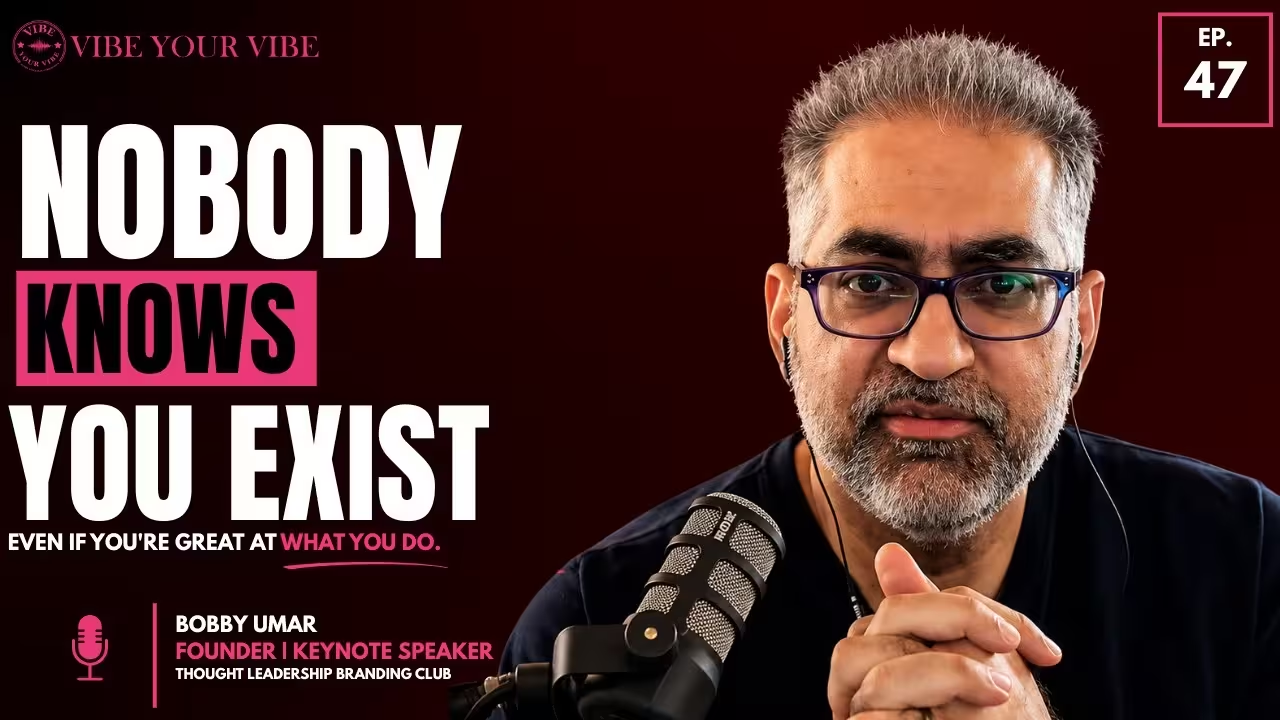
Nobody Knows You Exist: Bobby Umar on Visibility, Influence & Personal Branding
Bobby Umar Learn More About Bobby Play Episode Facebook Instagram Youtube Linkedin Keep Listening...
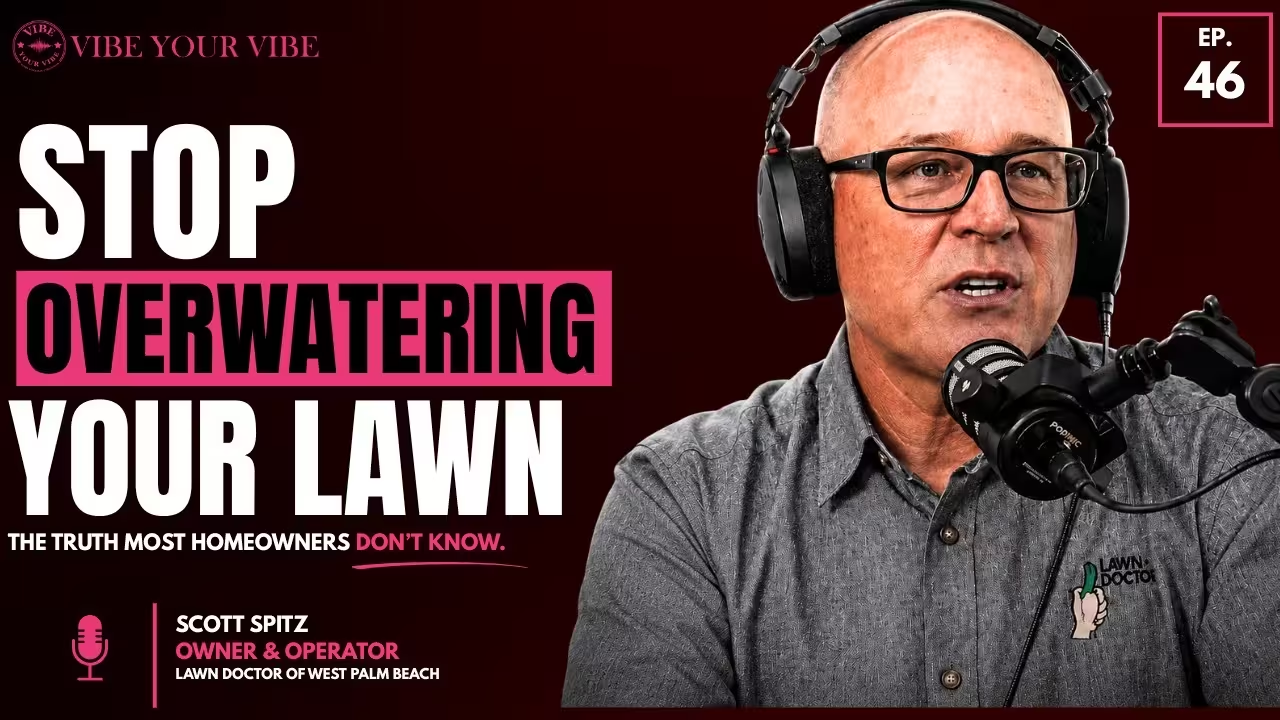
Stop Overwatering Your Lawn (And Every Other Mistake Florida Homeowners Make)
Scott Spitz Learn More About Scott Play Episode Facebook Instagram Youtube Linkedin Keep Listening...
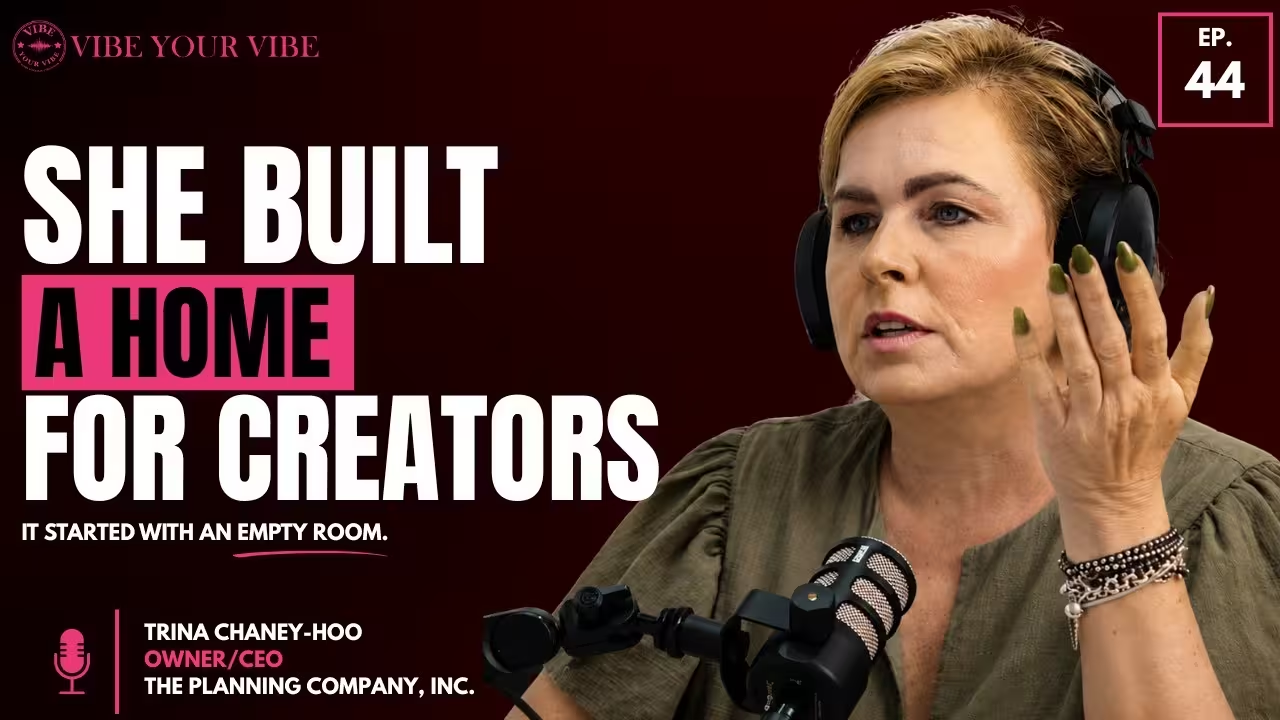
From Empty Warehouse to 120 Creators: Trina’s Studio 1016 Story
Trina Chaney-Hoo Learn More About Trina Play Episode Facebook Instagram Youtube Linkedin Keep Listening...
- How understanding your local market helps photographers set better prices and attract the right clients.
- Why developing a clear photography niche makes your brand easier to recognize and remember.
- How consistent lighting, color, and editing can create a stronger professional photography style.
- Why continuous practice helps photographers improve their technical skills and work more efficiently.
- How constructive feedback can help photographers improve their work and strengthen their creative direction.
- Why photographers need to price their services based on both market demand and business expenses.
- How focusing your website on specific services can improve visibility and attract more targeted clients.
- Why careful planning is important when rebranding a photography business or changing its website.
- How existing clients and local businesses can help photographers build visibility in new markets.
- Why specialization and strong branding are important for standing out in a competitive photography industry.
- Understanding your local market helps you set realistic prices and attract the right clients.
- A clear photography niche makes your brand easier for clients and search engines to understand.
- Consistent colors, lighting, and editing help create a recognizable professional style.
- Regular practice makes technical photography skills faster, easier, and more natural.
- Your pricing should reflect the real costs of running a professional photography business.
- Constructive feedback can push photographers to improve their work and strengthen their brand.
- Focusing your website on related services can improve your visibility and attract targeted clients.
- Rebranding requires careful SEO planning to protect your existing search rankings.
- Client relationships can help photographers build visibility in nearby markets and locations.
- Strong branding and specialization can help photographers stand out in a competitive market.
[00:00:00] That's when I I think it requires some
[00:00:02] intelligence and expertise to try to
[00:00:05] figure out where AI would be most
[00:00:06] useful. We're not trying to have AI go
[00:00:09] to this client's house and talk to them
[00:00:11] and talk to them about sensitive
[00:00:13] information. Vive your vibe. Let it
[00:00:17] collide.
[00:00:20] Find your tribe where truth can't hide.
[00:00:26] Hey, this is Kirk and today I have
[00:00:28] Caitlyn MSAS, the founder and CEO of Bot
[00:00:32] Queen. It's a missiondriven technology
[00:00:33] company helping businesses and
[00:00:35] nonprofits adopt AI and automation in
[00:00:37] practical human- centered ways. She's
[00:00:39] got over a decade of experience as an
[00:00:41] entrepreneur and activist. Caitlyn
[00:00:43] brings a unique blend of strategy,
[00:00:45] system thinking, social impact to her
[00:00:47] work, and she trains teams and audiences
[00:00:49] on how to actually use AI tools focus on
[00:00:52] clarity, implementation, and
[00:00:53] responsibility. responsible adoption
[00:00:56] rather than hype. Yeah, that's a bit a
[00:00:58] lot lot of hype out there. So, she's uh
[00:01:01] in addition to Bot Queen, she's a board
[00:01:03] member on Suits for Seniors, Palm Beach
[00:01:05] State College AI advisory community,
[00:01:07] part-time director of stewardship and
[00:01:09] strategy at the center of child
[00:01:11] counseling. Lives at the intersection of
[00:01:13] technology, ethics, education, service.
[00:01:15] >> So, let's go a little bit back. So, I I
[00:01:18] was born in Mexico and I moved to the
[00:01:21] United States when I was one. uh had a
[00:01:23] great childhood growing up here in Palm
[00:01:25] Beach County and since I was a young kid
[00:01:28] I always loved innovative projects. I
[00:01:31] grew up going to Monasuri school which
[00:01:33] is very project based and independent
[00:01:35] and um
[00:01:36] >> here here in Palm Beach County. So which
[00:01:37] school did you go to?
[00:01:38] >> So I went to a few different ones. I
[00:01:40] went to Children's House.
[00:01:41] >> Okay.
[00:01:42] >> Um and then I went to Summit and
[00:01:44] Claremont Monastery Schools. They since
[00:01:47] have both closed. And then I went to a
[00:01:49] college prep school. Shout out to Graham
[00:01:51] View. I actually spoke there last week
[00:01:53] in front of uh 200 students.
[00:01:55] >> Nice.
[00:01:55] >> Um just a a very like inspirational
[00:01:57] conversation about my journey as an
[00:01:59] entrepreneur and also uh you know the
[00:02:01] future of AI and how they can prepare
[00:02:03] for it.
[00:02:04] >> And so the what was the first school
[00:02:05] because that's one still going.
[00:02:06] >> Only one that's really around now is
[00:02:09] Children's House where I went to as a
[00:02:10] like basically preschool. Okay.
[00:02:12] >> And then the one that I graduated from
[00:02:14] >> which was
[00:02:15] >> Graham View.
[00:02:15] >> Graham View. Okay. So I'm going to if
[00:02:17] you don't mind I'm going to do a little
[00:02:18] shout out to number one education place.
[00:02:20] That's where my son went to school and
[00:02:22] graduated.
[00:02:23] >> Yeah. Montasauri is why I mentioned that
[00:02:26] K through 12 Monttoauri which
[00:02:28] >> I don't think he would have been he just
[00:02:30] really thrived there. Went from
[00:02:32] >> you know C's and D's and barely keeping
[00:02:35] Fs from showing up on the transcript
[00:02:37] too.
[00:02:38] He said I think I talked to him he said
[00:02:40] when he attended school there he got
[00:02:41] straight A's except for one B or B plus
[00:02:43] something like that. So he had one
[00:02:44] class.
[00:02:45] >> Oh wow.
[00:02:45] >> That you didn't get an A in.
[00:02:46] >> That's amazing.
[00:02:47] >> So it's just Yeah. It's a monosur. I
[00:02:49] just sorry I just really feel strong.
[00:02:51] >> Sorry plug. No, I definitely and I want
[00:02:53] to send my kids to Monasuri. I think
[00:02:55] it's probably one of the best types of
[00:02:57] education that there are like available.
[00:03:00] >> Well, a lot of people aren't going to
[00:03:02] aren't going to thrive in a traditional
[00:03:04] education academic environment,
[00:03:06] >> right?
[00:03:06] >> And there's all kinds of learning. So,
[00:03:08] everybody's different. There's all kinds
[00:03:10] of different intelligences. And I think
[00:03:12] one way to address monatory I don't
[00:03:15] think it's the end all be all but it's
[00:03:17] it's an alternative to those that are
[00:03:19] struggling with a traditional academic
[00:03:22] environment. That's that's
[00:03:23] >> I don't even think it's for people that
[00:03:25] are struggling. I actually think it's
[00:03:26] more for people that want to be able to
[00:03:29] think outside the box and be
[00:03:30] independent.
[00:03:31] >> You're right. I'm sorry that that's a
[00:03:33] really bad way to put it.
[00:03:35] >> Think outside of the box. And also the
[00:03:37] other thing where a lot of kids at his
[00:03:38] school go to the reason why they go to
[00:03:40] SC to school there is cuz they're
[00:03:42] involved in automobile racing, horse
[00:03:46] events, whether that's polo or other
[00:03:48] types of um help me out, what's it
[00:03:50] called with the horse um the equestrian
[00:03:53] sports and you know dance or whatever it
[00:03:56] might be, martial arts. And what his
[00:03:59] school allows for is that flexibility. A
[00:04:03] lot of kids that go to school there
[00:04:04] where he graduated from are in travel
[00:04:06] sports.
[00:04:07] >> Yeah.
[00:04:07] >> And so the school has the flexibility to
[00:04:09] allow these students to participate in
[00:04:12] all of these activities. So you're
[00:04:13] right. It's not just it it's it's
[00:04:15] thinking outside of the box and
[00:04:17] providing a a better um how do I want to
[00:04:19] say just uh environment for the for
[00:04:22] these kids so that they can experience
[00:04:24] all these other things that they're
[00:04:25] actually very talented in.
[00:04:26] >> Yeah. Yeah. And I also think the school
[00:04:29] that I graduated from was very project
[00:04:31] based at the time. Like project based
[00:04:34] learning was a huge thing. And so I was
[00:04:36] able to do a lot with that. I started my
[00:04:38] own um club at my school focused on um
[00:04:42] empowering women feminism kind of at the
[00:04:44] wake of like me too talking about gender
[00:04:46] equality which I mean we'd been talking
[00:04:49] for years about but not really in a
[00:04:51] school setting. I really appreciated
[00:04:53] that about my high school. I got it the
[00:04:55] ability to be involved in dance and
[00:04:57] musical theater. Uh, and I think a lot
[00:05:00] of those skills that I learned there are
[00:05:02] very transferable. And so that's kind of
[00:05:04] what I was talking about in my uh
[00:05:06] presentations to two different student
[00:05:08] groups last week was the fact that they
[00:05:10] might not know it, but what they're
[00:05:12] learning and experiencing right now in
[00:05:15] school or even in college is going to be
[00:05:17] super transferable to the workforce.
[00:05:20] >> Uh, like musical theater, for example.
[00:05:22] Musical theater teaches you how to have
[00:05:24] stage presence, you know, how to become
[00:05:26] a character, storytelling, which is a
[00:05:28] lot of the work that I do now in terms
[00:05:30] of training, in terms of speaking. Um,
[00:05:32] really builds upon all of the work that
[00:05:35] I did.
[00:05:36] >> Getting up on top, getting on the stage
[00:05:37] and actually speaking to an audience.
[00:05:39] It's a big deal.
[00:05:40] >> And presence, tone, even right now, like
[00:05:43] what we're doing right now is is really
[00:05:44] based on a lot of the like vocal
[00:05:47] training that I had when I used to do
[00:05:48] singing and things like that. I I was in
[00:05:50] an a capella group and it was that was
[00:05:52] the time of my life. So, I definitely
[00:05:54] would love to eventually get back to
[00:05:56] some of that uh theater and arts. The
[00:05:58] million-dollar question, how did I get
[00:06:00] here? Um I think I' I've always wanted
[00:06:03] to be an entrepreneur in a sense and I
[00:06:05] always wanted to have my own uh business
[00:06:07] or nonprofit. And so, I spent uh a while
[00:06:12] doing a lot of nonprofit work and then
[00:06:14] around 2 three years ago was really like
[00:06:16] the beginning of of the AI revolution. I
[00:06:18] mean, AI had been around for several
[00:06:21] years before that, but not until like
[00:06:23] the release of Chad GBT, I would say, in
[00:06:25] like 2022, that people really started
[00:06:27] using it as regular everyday people. And
[00:06:30] so, I really wanted to be the person.
[00:06:32] >> So, repeat that again. I think that's
[00:06:34] really important. When did this thing
[00:06:35] start?
[00:06:36] >> 2022.
[00:06:37] >> 2022. But the actual tools been around
[00:06:41] for how long?
[00:06:42] >> I mean, they started around six, seven
[00:06:44] years ago. um you know working on
[00:06:47] artificial intelligence.
[00:06:48] >> So working on the development of these
[00:06:50] models and testing them but really the
[00:06:52] the big release to the public has only
[00:06:54] been in the last few years.
[00:06:56] >> The last few years but I mean the
[00:06:57] technology I guess the point I'm trying
[00:06:58] to make this isn't like brand new.
[00:07:00] >> I mean it's not like super brand new. So
[00:07:02] like 1956 is when artificial
[00:07:04] intelligence first started to really
[00:07:06] make a name as like a concept.
[00:07:08] >> Mhm. And then over the years, I mean, I
[00:07:10] don't know if you remember, but there
[00:07:12] was like this computer, um, I think it
[00:07:14] was called Deep Blue that was actually
[00:07:16] Watson.
[00:07:16] >> Yeah. All of that. So, it's it's like
[00:07:19] new, but it's not.
[00:07:20] >> So, the concept
[00:07:21] >> post 2000, like 2000 2010s, I think, is
[00:07:24] when Watson was
[00:07:25] >> right
[00:07:25] >> kind of prevalent, but it's it's it's
[00:07:28] still pretty new, but it's like you
[00:07:29] said, it's been around for
[00:07:31] >> for a long time,
[00:07:32] >> for a while. Precoid, right? I mean, I
[00:07:35] wasn't even aware of it until recent
[00:07:37] using like things like Grammarly for a
[00:07:39] long time. I mean, it's been
[00:07:40] incorporated in algorithms that we've
[00:07:42] been using for a pretty long time, but I
[00:07:44] think
[00:07:44] >> they didn't package it into this chatbt
[00:07:46] until like
[00:07:47] >> 2022.
[00:07:49] I think the when I say like the real AI
[00:07:51] revolution, I think really began with
[00:07:53] that release because now we have Grock,
[00:07:56] we have Gemini, and they're all
[00:07:57] competing right to become the best, the
[00:07:59] fastest, the cheapest, etc. So that real
[00:08:02] race I think started only in the last
[00:08:04] like four or five years.
[00:08:05] >> What's amazing is you you see because
[00:08:08] I'm I'm I'm a user of Gemini Grock Heat
[00:08:12] and um Perplexity and I haven't dabbled
[00:08:15] yet in the Claude. They all have their
[00:08:17] strengths. And what's interesting is
[00:08:19] that they're just, you know,
[00:08:20] >> they're all just like, oh, one comes out
[00:08:22] with something and then the other one
[00:08:23] comes out with something and then one
[00:08:25] releases a new project that they're
[00:08:26] doing and then the other one does
[00:08:28] something similar. They try to one up
[00:08:30] each other. Um I
[00:08:31] >> that's happening at the speed of light
[00:08:33] almost because I I I how I I don't know
[00:08:35] how familiar you are with photography. I
[00:08:37] kind of liken it to, you know, Canon,
[00:08:39] Sony, and Nikon, you know. Okay. Well,
[00:08:41] this year, you know, the best camera is
[00:08:44] probably Canon. And then next year, you
[00:08:46] know, Nikon's going to edge everybody
[00:08:47] out. And then the next year Sony's like
[00:08:49] get their act together and they're going
[00:08:50] to beat everybody. This is not on a
[00:08:52] yearby. This is on a probably like
[00:08:54] weekly if not daily basis which is
[00:08:57] making it really hard for the average
[00:08:59] person to keep up with this. It's very
[00:09:01] overwhelming even for myself and my
[00:09:03] team. I work with a local team out of
[00:09:05] Melbourne, Florida. I've been working
[00:09:06] with them almost since I started uh in
[00:09:08] the space and uh they are an AI
[00:09:10] development studio. What does that mean?
[00:09:12] They have a lab and really they build um
[00:09:15] foundationally they build tech. And so
[00:09:18] I've really learned and worked alongside
[00:09:20] them for the last few years. even for
[00:09:22] them to keep up with all of the updates
[00:09:23] and everything that's happening, it's
[00:09:25] it's overwhelming. So, you need an AI
[00:09:27] trained to keep you up to date and up to
[00:09:29] speed with everything that's happening
[00:09:30] in the space. But I think what I always
[00:09:32] recommend is pick a tool cla
[00:09:37] and start to really experiment and and
[00:09:39] think about like you're like a little
[00:09:41] tinkerer. You're going in, you're trying
[00:09:42] things out. I advocate for YouTube. It's
[00:09:45] an amazing resource to be able to learn
[00:09:48] um how to perform these specific
[00:09:50] prompts. Um there's a lot of new
[00:09:52] integrations that are happening. And so
[00:09:54] I really think that what is going to set
[00:09:57] people apart is going to be their
[00:09:58] curiosity and their ability to also dive
[00:10:01] deep and use AI for their particular use
[00:10:04] case. So what's a use case? It means how
[00:10:06] they're going to be uh applying it to,
[00:10:09] for example, a specific workflow or
[00:10:11] maybe they're applying it to a specific
[00:10:13] task that they're doing. and it's going
[00:10:15] to look differently like somebody who is
[00:10:17] in admin, they're going to use it
[00:10:19] differently than a doctor, right? And so
[00:10:22] I think now uh what I'm seeing and and
[00:10:24] what I'm training people on is how to
[00:10:26] niche down into their specific industry
[00:10:29] and then even deeper into their specific
[00:10:31] department and role. Um because that's
[00:10:33] where you're really going to see
[00:10:34] measurable return on investment is when
[00:10:36] people are really using it. Um today I
[00:10:38] was on with a a prospect and um it was
[00:10:41] brought up Javier who's our technical
[00:10:43] solutions architect. He basically said
[00:10:45] like if you use a prompt and you do it
[00:10:47] correctly, you can save on average 3
[00:10:49] minutes of your time.
[00:10:51] >> Mhm.
[00:10:51] >> So think about it across an entire
[00:10:53] enterprise.
[00:10:53] >> And what happens if you use it
[00:10:54] incorrectly?
[00:10:55] >> I mean you're not going to save as much
[00:10:56] time.
[00:10:57] >> Mhm.
[00:10:57] >> So basically how we've structured
[00:10:59] ourselves in capitalism, time equals
[00:11:01] money.
[00:11:02] >> Right. Right. I I would venture to say
[00:11:04] if you use if you don't know how to
[00:11:05] write prompts very well, you're actually
[00:11:06] going to spin your wheels and actually
[00:11:08] take maybe take more time.
[00:11:09] >> Well, let me just tell you that the hack
[00:11:11] to writing prompts is to have AI write
[00:11:13] the prompts for you.
[00:11:15] >> Correct. You have you actually have the
[00:11:18] AI write the prompt for you.
[00:11:19] >> Exactly. And
[00:11:20] >> that can we just let's just repeat that.
[00:11:23] Stop trying to write your own prompts.
[00:11:25] You have the AI write the prompt for
[00:11:28] you.
[00:11:29] >> Yes.
[00:11:29] >> That's like really critical. I don't
[00:11:32] think a lot of people know that. I think
[00:11:33] if you've been involved in the space,
[00:11:35] that just seems like second nature to
[00:11:37] you. But on average, the people that I
[00:11:40] train, uh, a lot of folks are small
[00:11:42] business owners or, you know, they run
[00:11:44] nonprofits or, you know, they're just
[00:11:45] staff. uh they're spending time like
[00:11:47] click clacking like create an email for
[00:11:50] me instead of putting on the dictate
[00:11:52] feature you know the little icon that's
[00:11:54] the microphone and being like hey so I'm
[00:11:57] trying to do an analysis today to find
[00:11:59] out do an analysis on my P&L over the
[00:12:01] last 3 months whatever it is that you
[00:12:03] want can you create me a prompt that's
[00:12:05] going to help me do XYZ I want the
[00:12:07] outcome to be XYZ so giving it a bunch
[00:12:10] of information and being really clear
[00:12:12] and specific and then having it create
[00:12:14] for you a really kick-ass prompt
[00:12:16] And then you can go in and refine that,
[00:12:18] >> you know, and then after that, once
[00:12:20] you're running these prompts, you can
[00:12:22] iterate. So you can type in certain
[00:12:24] questions like, hey, I'm actually trying
[00:12:26] to figure out this instead of that or if
[00:12:29] I was an expert in this, what would I
[00:12:31] need to be thinking about? So really be
[00:12:33] using it as an assistant rather than
[00:12:35] just kind of a write me an email and uh
[00:12:38] help me out with this specific small
[00:12:40] task,
[00:12:41] >> right? Or I'm in the marketing space,
[00:12:43] you know, and I have clients and
[00:12:44] prospects. write me this create this
[00:12:46] marketing proposal for me.
[00:12:48] >> What marketing proposal for who? It's
[00:12:50] like think about an intern. Like let's
[00:12:52] say we had an intern sitting with us
[00:12:54] right now here. His name is Jimmy. Would
[00:12:56] you just say, "Hey, Jimmy,
[00:12:58] >> go write me a marketing proposal.
[00:12:59] >> Write me a strategic plan for a
[00:13:01] nonprofit. Which nonprofit? What's
[00:13:04] what's even is a strategic plan?"
[00:13:05] >> You need to give them the basics.
[00:13:07] >> Exactly. And then I I've also been a
[00:13:09] huge fan of some of these new
[00:13:11] integrations. Some of them I'm not a big
[00:13:13] advocate for. I think connecting your uh
[00:13:15] email and things like that could put you
[00:13:16] a lot of security risks but uh there's
[00:13:19] some new integrations like with Canva.
[00:13:21] Uh so Canva is a different platform that
[00:13:23] you can basically create powerpoints and
[00:13:25] social media content. So now it's
[00:13:27] integrated with like chat QBT and so you
[00:13:30] can be brainstorming and thinking about
[00:13:32] oh I want to create this PowerPoint and
[00:13:34] then it can make an amazing outline and
[00:13:36] then you can go and edit it and refine
[00:13:37] it in Canva and it has that
[00:13:40] connectivity. So I think right now what
[00:13:42] I'm seeing in this space is especially
[00:13:44] for clients that really want to
[00:13:45] implement AI, they need to do some
[00:13:47] cleanup in terms of helping to connect
[00:13:50] their different platforms together. Like
[00:13:52] everyone has like 20 different platforms
[00:13:54] that they're using and moving between
[00:13:56] screens, right? The future, which what
[00:13:59] we're seeing in the space is going to be
[00:14:01] where these platforms are all talking to
[00:14:03] each other and there's a basically a
[00:14:05] foundational layer of artificial
[00:14:06] intelligence, which is what my my team
[00:14:08] is building. We're basically building an
[00:14:10] agent that would be able to connect to
[00:14:12] your CRM, your accounting software, your
[00:14:15] documents and things like that. And so
[00:14:17] rather than just migrating and going
[00:14:19] from one platform to the other, you're
[00:14:21] actually working within all of them
[00:14:23] together.
[00:14:24] >> Okay.
[00:14:25] >> Um and so that's what we're seeing and
[00:14:27] and hopefully that moves in the in the
[00:14:29] next year. And I also think that one of
[00:14:32] my my biggest conversations I think has
[00:14:34] been just because you say that you're
[00:14:37] implementing AI doesn't mean you
[00:14:39] actually have. And so that kind of goes
[00:14:41] along with what you're talking about the
[00:14:42] hype,
[00:14:43] >> right?
[00:14:43] >> So I'll give you an example. So a lot of
[00:14:46] folks in the small business and
[00:14:47] nonprofit space, they have Microsoft,
[00:14:50] right? Microsoft 365. And everyone's
[00:14:52] like, I have co-pilot,
[00:14:53] >> right?
[00:14:54] >> Okay, you have it. So I I got called in
[00:14:56] to a client. I've done probably five or
[00:14:58] six trainings with them. Two weeks ago,
[00:15:00] I walk into the room and I had already
[00:15:02] pre-planned this. There was probably 10
[00:15:04] women there, all between the ages of
[00:15:06] like 35 to 60, and I was like, "Okay,
[00:15:09] today we're going to go over and teach
[00:15:12] everybody here how to use Copilot." And
[00:15:14] I was like, "Has anybody been using it?"
[00:15:16] There was like two people that had used
[00:15:18] it. And what I learned is that they had
[00:15:21] all been seeing it on their interface,
[00:15:23] but they've never clicked it. They've
[00:15:24] never used it. They were like, "Oh,
[00:15:26] that's what that little rainbow like
[00:15:28] squiggly thing is. It's like it's kind
[00:15:30] of like a circle squiggly thing,
[00:15:32] >> right? Yeah.
[00:15:32] >> And um I don't even know what that shape
[00:15:34] is. What shape is that?
[00:15:36] >> I know what you're talking about,
[00:15:36] though.
[00:15:37] >> Yeah. It's kind of like a squiggle
[00:15:38] circle thing. And they were like, I had
[00:15:40] no idea. And it's because the
[00:15:43] leadership, in my opinion, just assumed
[00:15:45] that just because it exists, it's going
[00:15:47] to be used.
[00:15:48] >> No, it's not going to happen that way.
[00:15:50] >> And so we went through a whole training
[00:15:52] teaching them how to write emails uh
[00:15:54] with Copilot through Outlook. So, on the
[00:15:57] same interface, teaching them how to
[00:15:59] create flyers, teaching them how to call
[00:16:01] up different documents and summarize
[00:16:03] them,
[00:16:03] >> telling the AI not to use an M dash.
[00:16:05] >> Oh my gosh, that's funny. Uh, they
[00:16:08] actually have fixed that. That was in
[00:16:10] one of the latest like updates with 5.2
[00:16:13] where Sam Alman came out and he was
[00:16:14] like, "The M dash, it's not going to be
[00:16:16] as present anymore."
[00:16:17] >> It's still there.
[00:16:18] >> It's still there.
[00:16:19] >> It's still there. Not Not as legit, not
[00:16:21] as bad. Yeah. Still there. It's
[00:16:24] interesting because there was I was
[00:16:26] reading something like a few months ago
[00:16:27] that was saying that certain words are
[00:16:30] now going to be more prominent in the
[00:16:33] English language because of these models
[00:16:36] because the people that trained them
[00:16:39] decided that these were the words that
[00:16:40] we were going to use for the output
[00:16:42] >> or the writing techniques or whatever.
[00:16:44] >> Exactly. So then now that just gets and
[00:16:46] now all the content on LinkedIn and
[00:16:48] Facebook and everything is AI and so it
[00:16:50] just gets recirculated and reread by
[00:16:54] both AIs and humans. So it's just like
[00:16:56] it's mindblowing.
[00:16:57] >> It's actually impacting the lexicon.
[00:17:00] >> Exactly. That's a good way to put it. Um
[00:17:02] and it's impacting our ability to even
[00:17:05] communicate. Right.
[00:17:07] >> Cuz now we're thinking, oh well that
[00:17:08] that's a that's a word that everybody
[00:17:09] uses. It's actually not.
[00:17:11] >> No. So it's it's fascinating how
[00:17:13] basically
[00:17:14] >> how do you feel about all the content
[00:17:15] getting created because I almost feel
[00:17:17] like almost probably what 90 plus% of it
[00:17:20] is AI.
[00:17:21] >> I mean I don't know the stats on exactly
[00:17:23] how much content is produced
[00:17:24] >> when I'm saying let me clarify talk
[00:17:27] about having to clarify
[00:17:29] >> clarify it.
[00:17:30] >> I'm talking about the con so you have
[00:17:32] the bot created content. I'm not really
[00:17:34] talking about that. I'm talking about
[00:17:36] the content that people create for
[00:17:37] themselves but they're using the AI to
[00:17:39] write it for them. What I mean I would
[00:17:41] say
[00:17:43] in the 90 percentile.
[00:17:45] >> I mean I think
[00:17:46] >> I see lots of M dashes and I see a lots
[00:17:48] of the way they format the triples and
[00:17:50] everything else
[00:17:51] >> right when it's like um Chad GBT in
[00:17:54] these models they love to do like three
[00:17:56] adjectives in a row. Um but the thing is
[00:17:59] that that's actually how I learned it as
[00:18:01] well in school. Like it was like blue,
[00:18:03] red and yellow. So some of it I think
[00:18:06] might be still human
[00:18:07] >> somewhat legitimate for the top top
[00:18:10] level writer. This is how they're going
[00:18:11] to write.
[00:18:12] >> I mean it's interesting. So I have a
[00:18:14] friend who she's my best friend. She
[00:18:16] actually works in medical writing. And
[00:18:17] so she and her company completely have a
[00:18:20] zero AI policy. They're essentially
[00:18:23] she's a microbiologist and they're
[00:18:25] taking all of this hard science. So all
[00:18:27] of these graphs and you know really like
[00:18:31] statistical analysis that have been done
[00:18:33] with really fancy sciency words and
[00:18:35] they're creating for example journals
[00:18:37] and things like that that will be more
[00:18:38] digestible to the larger medical and
[00:18:41] student community. And so she has a very
[00:18:43] like solid no AI policy and and she's a
[00:18:46] big believer right now that that's going
[00:18:48] to stay like that at least for the
[00:18:49] foreseeable future specific to that
[00:18:52] industry. But I think when you're
[00:18:53] talking about LinkedIn I'm like I'm m
[00:18:55] I'm dashed out. You can even see people
[00:18:57] don't even take the time now to separate
[00:18:59] the paragraphs. I'm like, why am I
[00:19:01] reading just like word salad? It's like,
[00:19:03] you know what I mean? Have you seen
[00:19:04] that?
[00:19:04] >> Yes, I've seen that. Yes.
[00:19:06] >> And I think honestly what's going to
[00:19:07] happen in my opinion is that we're going
[00:19:10] to kind of maybe even get even deeper
[00:19:13] into some of the video content. I think
[00:19:15] we're already seeing that where people
[00:19:16] are consuming even more of the video
[00:19:18] content that's also AI generated. But I
[00:19:21] think what will stand out is
[00:19:22] >> like the gorilla podcast.
[00:19:23] >> Yes. I think what will really stand out
[00:19:26] is is people putting their authenticity
[00:19:28] on it.
[00:19:28] >> Well, that's what I keep that's what I
[00:19:30] tell my team. So, we do marketing
[00:19:32] >> and as part of what we do and I keep
[00:19:35] telling them authenticity is going to
[00:19:37] win in the end with all of this stuff.
[00:19:40] >> Yeah. And I don't know if you've seen
[00:19:41] this woman um I forget her name, but
[00:19:43] she's become super famous. She's a
[00:19:46] teacher and she makes these like uh
[00:19:48] these onion cups and these eggs and she
[00:19:50] just basically films herself eating the
[00:19:52] food that she likes to eat. and she went
[00:19:54] viral. I think she was even on the
[00:19:55] Jennifer Hudson show. But she's not
[00:19:58] curated like the way that she positions
[00:20:00] herself is she's a mom, she's a teacher,
[00:20:02] and she's sharing the food that she
[00:20:03] likes to eat online, you know, and it's
[00:20:05] that's what's like kind of jaw-dropping
[00:20:07] now. You're like so used to these
[00:20:09] proposals and people getting
[00:20:10] >> Well, that's why I like the way I do my
[00:20:11] show. It's like I mean, I have some qu
[00:20:13] like I told you when we started, I have
[00:20:15] some questions prepared depending, you
[00:20:17] know, I don't know you super well.
[00:20:20] Sometimes I have I we actually this is
[00:20:22] the first time we met. I haven't had a
[00:20:23] chance to have a conversation, but I
[00:20:25] mean with you saw me close my laptop
[00:20:27] within the first couple of seconds I'm
[00:20:29] like, "Okay, this is good. I don't need
[00:20:30] those questions."
[00:20:31] >> Sometimes I keep them open, but and
[00:20:33] usually I have cards printed that didn't
[00:20:34] work out for whatever reason today.
[00:20:36] Yeah. But at the same time, you know, I
[00:20:38] think these authentic conversations that
[00:20:40] can we allow to go down a rabbit hole, I
[00:20:44] think people are going to really crave
[00:20:45] that. Maybe. I don't know. Maybe I could
[00:20:47] be wrong.
[00:20:47] >> I think we're already seeing that with
[00:20:49] the live shopping.
[00:20:51] >> Oh, right.
[00:20:52] Amazon.
[00:20:53] >> I mean, we're already you're
[00:20:53] >> talking about the Amazon.
[00:20:54] >> Yeah. I mean, there's um through Shopify
[00:20:56] as well, even through like I think
[00:20:58] Instagram is working on something or I'm
[00:21:00] not sure on that space, but I've heard a
[00:21:02] lot of folks talking about the live
[00:21:03] shopping, the live streaming has already
[00:21:05] become a very popular form of
[00:21:07] entertainment. Uh I mean, we've seen for
[00:21:08] years the vloggers, you know, people
[00:21:11] basically like vlogging about their
[00:21:12] lives, their kids, you know, their
[00:21:14] hobbies, their passions. So, we
[00:21:16] definitely crave some of that. I mean,
[00:21:17] you can see it even on reality TV,
[00:21:20] >> right? Um, so I think that there might
[00:21:22] there's definitely going to be a
[00:21:23] continuation of that. Um, but I think
[00:21:25] it's getting harder and harder now for
[00:21:27] us to differentiate between AI generated
[00:21:29] content and not I mean I even have a
[00:21:31] hard time now. There's like influencers
[00:21:33] now that are not real influencers.
[00:21:35] They're they're AI.
[00:21:37] >> They're AI. I mean the the the tells are
[00:21:40] are getting smaller and smaller. Used to
[00:21:43] all they moved was her head,
[00:21:44] >> right? Well, now they have full stories.
[00:21:47] They have full lives,
[00:21:48] >> which you know I'm talking about. It
[00:21:49] used to be just a head. A talking head.
[00:21:51] >> Yeah. It was like an avatar,
[00:21:52] >> right? And then the body just kind of
[00:21:54] sat there or maybe then they started
[00:21:55] moving. Now it's like full on.
[00:21:57] >> Yeah. That you you're like,
[00:21:59] >> "Is that real?" Cuz it looks the latest
[00:22:02] stuff looks
[00:22:03] >> pretty authentic.
[00:22:05] >> Like almost even the texture of the skin
[00:22:09] >> is really well mimicked in my opinion.
[00:22:12] >> Um but kind of to add some focus, I I
[00:22:14] really am I'm excited. I'm a huge
[00:22:16] optimist in the fact that, you know,
[00:22:18] we've made it through a lot of different
[00:22:19] challenges as humanity and so we will
[00:22:22] prevail in this next phase as well.
[00:22:24] Hopefully, unless we get all taken out
[00:22:26] by aliens or something. Um, I hope
[00:22:28] that's quick.
[00:22:30] >> I don't think that's likely. No, I'm I'm
[00:22:32] making a joke, but
[00:22:33] >> I think Well, no, I know you're making
[00:22:34] the joke, but I mean, I think that's
[00:22:36] like uh our species in existence to an
[00:22:40] advanced civilization, an alien species,
[00:22:42] I think, is uh probably like li like li
[00:22:44] like li like li like li like li like li
[00:22:45] like li like li like li like li like li
[00:22:45] like li like li like li like likeness of
[00:22:45] us to like maybe I don't know some
[00:22:47] microbe in the dirt
[00:22:50] >> I I I mean I think we're definitely more
[00:22:52] advanced. I I will say that I'm really
[00:22:54] looking forward to some
[00:22:56] >> No, I'm saying in comparison, you know,
[00:22:58] they're just not going to care. No,
[00:23:00] that's what I'm trying to say. Yeah, I
[00:23:02] don't think they're going to care. They
[00:23:03] might look at us and go, "Oh, that's
[00:23:04] interesting. Those those monkeys down
[00:23:06] there."
[00:23:06] >> Just give us a
[00:23:08] >> a little bit of a flick. Um, but I think
[00:23:11] >> one of the things I'm really excited
[00:23:13] about and hopefully I get to see this in
[00:23:15] my own lifetime. Um, I've been a huge
[00:23:18] advocate for, you know, reform in the
[00:23:20] workplace and and work life balance and
[00:23:22] I'm really excited to hopefully see some
[00:23:25] changes in that space. I think the 9 to5
[00:23:28] hasn't been working for people. I also
[00:23:30] don't think it works if you're like a
[00:23:31] contractor or a freelancer. I think, you
[00:23:33] know, I'm hoping to see some changes
[00:23:36] with that regard.
[00:23:37] >> Like what in regard like more things are
[00:23:40] more um what's the word I'm looking for?
[00:23:43] Results results
[00:23:44] >> results driven. I mean, I think we're
[00:23:46] seeing that more and and thank God for
[00:23:48] co in that way where people were able to
[00:23:50] kind of make their own schedules and
[00:23:51] things like that. But even now it's like
[00:23:53] >> at the end of the day that's what
[00:23:54] matters more than anything, right? Not
[00:23:56] how many hours you put in, when you
[00:23:58] showed up, when you left.
[00:23:59] >> Exactly. I mean,
[00:24:00] >> did you get it done? And did you get it
[00:24:01] done in a timely manner?
[00:24:02] >> If it if it takes you 10 hours to close
[00:24:05] a million dollar deal, I'd rather have
[00:24:08] that person then they can go close
[00:24:09] another million-dollar deal rather than
[00:24:11] having someone just kind of BS their way
[00:24:13] the entire year to close that same
[00:24:15] million-dollar deal. Right. And also, I
[00:24:18] think it's going to be more valuable
[00:24:19] their communication skills and their
[00:24:20] ability to be innovative.
[00:24:22] >> Well, I'll even pitch something
[00:24:23] different to you. So the other side of
[00:24:25] that is that for the guy that closes a
[00:24:27] million dollar deal in 10 hours versus a
[00:24:29] guy that takes maybe 6 months or a year,
[00:24:31] which one's going to be more sticky? I
[00:24:32] mean, that's
[00:24:33] >> can make a difference, too.
[00:24:34] >> I don't know. I I'm I'm definitely
[00:24:36] interested to see how basically the
[00:24:38] revolution of work around AI. I mean,
[00:24:40] we've seen a huge mass firings really
[00:24:42] related to the rise of automation and
[00:24:45] and artificial intelligence. U McKenzie,
[00:24:47] which is one of the largest consulting
[00:24:49] companies, they fired a bunch of uh
[00:24:51] consultants. They're building their own
[00:24:53] like agentic consulting bot or something
[00:24:55] like that now. And so I'm I'm really
[00:24:57] interested to see if companies are
[00:25:00] really going to move forward with this
[00:25:01] 9-to-F5 full-time hire or if they're
[00:25:04] going to diversify. Uh we're also seeing
[00:25:06] a huge rise in VAS and offshore uh folks
[00:25:09] that are working in other countries like
[00:25:11] specifically like the Philippines and
[00:25:12] India and even in South America. So I'm
[00:25:15] I'm interested to see like in the next
[00:25:17] like 10 years what happens to the
[00:25:19] workforce. And there's also a lot of
[00:25:21] other issues like the rising cost in
[00:25:22] healthcare, the rising cost of food. So,
[00:25:24] how are we really going to manage all of
[00:25:26] these issues at once while still
[00:25:28] creating highquality output and
[00:25:30] highquality businesses?
[00:25:32] >> Yeah. Which aren't just cookie cutter
[00:25:34] stuff,
[00:25:35] >> right? It's like super complex. So, I I
[00:25:38] really hope that that more conversation
[00:25:40] is had about, you know, not just the
[00:25:42] hours. It's like, oh, how many hours did
[00:25:45] you work? Like a lot of stuff takes me
[00:25:46] like 10 minutes. But I also think about
[00:25:48] it for a long time. For example, like a
[00:25:51] presentation that I might create is
[00:25:53] like, you know, I go on walks, I think
[00:25:55] about it. I think about the order. The
[00:25:57] actual time that I'm spending creating a
[00:26:00] presentation might just be in 1 hour,
[00:26:02] >> right? But the thing is is if you're in
[00:26:04] a traditional 9 to5, it might be 5:30.
[00:26:06] You're driving home and you're like,
[00:26:08] "Oh, that's what I need to put in there,
[00:26:10] >> right?
[00:26:10] >> 30 minute or 45 minute commute. That
[00:26:14] where does that get accounted for?"
[00:26:15] >> Well, yeah. And and
[00:26:16] >> that's the and I think that's kind of
[00:26:17] what you're addressing. You're saying
[00:26:19] >> so so I'm stealing this from my best
[00:26:21] friend. Her name is Amanda. So she says,
[00:26:22] "If I'm thinking about you, I'm
[00:26:24] working."
[00:26:25] >> Well, I say I say the same thing and my
[00:26:27] wife would give me so much crap about
[00:26:29] that cuz I'll be driving the car, taking
[00:26:31] the kids somewhere, and they're like,
[00:26:32] "Are you working?" I go, "Yeah, I'm
[00:26:34] working. I'm thinking about it."
[00:26:35] >> Yeah, I'm I'm I'm thinking about you.
[00:26:38] >> I'm I'm with your best friend, Amanda.
[00:26:41] >> She's like, "You know what? I feel the
[00:26:43] same way though because it's it's your
[00:26:45] mental capacity and mental space and
[00:26:47] it's like that's the the same work that
[00:26:49] has never been accounted for for women.
[00:26:51] You know, your husband comes home, he's
[00:26:53] like, "What have you been doing all
[00:26:54] day?" Well, I've been keeping track of
[00:26:55] this entire place, the kids, the
[00:26:58] schedule, the groceries.
[00:26:59] >> Oh, you're talking about the stay at
[00:27:00] home mom.
[00:27:01] >> Yeah. I mean, I feel like
[00:27:02] >> the woman that has only one job.
[00:27:03] >> I mean, she has a thousand of them.
[00:27:05] >> Well, I'm just saying as a stay-at-home
[00:27:07] mom, she's just got the one job. She's
[00:27:09] not doing a career and you where I'm
[00:27:12] going. Like the the mom's got that's
[00:27:15] like as you were saying that's a
[00:27:17] full-time.
[00:27:18] >> Yeah. And it's 24/7
[00:27:20] >> and then you got the kids and then she's
[00:27:21] supposed to go work for eight hours a
[00:27:23] day somewhere too.
[00:27:24] >> Well, now you got to work because you
[00:27:25] can't afford if you don't have two
[00:27:26] incomes like it's not going to happen.
[00:27:28] Yeah. I definitely think the mental
[00:27:30] >> traditional woman in the last I don't
[00:27:33] know how many maybe you know the answer
[00:27:35] to that. She's she's working multiple
[00:27:37] jobs. Yeah, this is true.
[00:27:39] >> How does she ever get to sleep? Because
[00:27:41] her brain's going crazy because she's
[00:27:42] thinking about the orthodontist
[00:27:44] appointment and then the dance lessons
[00:27:45] and then the tutor and the teacher
[00:27:48] appointment and then she's got her job
[00:27:50] and her boss and her coworker and
[00:27:52] >> that's why so many women are like super
[00:27:54] tired and burnt out and then, you know,
[00:27:56] it just doesn't function or work.
[00:27:58] There's not enough hours.
[00:28:00] >> So, is there anybody ever talking about
[00:28:01] this? Is this
[00:28:02] >> I mean, I I do think so. I think I mean
[00:28:04] you know a lot of folks keep keep saying
[00:28:06] like oh like you can have it all and
[00:28:08] stuff like that. I think I think you can
[00:28:09] have it all in the right partnership and
[00:28:12] in the right situation and there are a
[00:28:14] lot of women that I follow like on
[00:28:16] social media that are now talking about
[00:28:18] this where they are open and honest. One
[00:28:20] of them is uh Melissa Wooderberg. I mean
[00:28:22] she her husband owns like the towel
[00:28:24] group and you know she's very well off
[00:28:26] and she has her own business but she's
[00:28:28] been open about the fact that she has a
[00:28:29] lot of help. I mean, she's got a nanny,
[00:28:31] she's got a housekeeper, all these
[00:28:33] people that are are helping her. She has
[00:28:35] her own team that works with her. So,
[00:28:36] she teaches uh Pilates and yoga and all
[00:28:38] these classes like online and in person.
[00:28:41] And she's a big influencer. She's like
[00:28:43] got millions of followers. And so, she's
[00:28:45] I appreciate that because the folks that
[00:28:48] are just like, "Oh, you can have it
[00:28:49] all." But then they don't show you what
[00:28:50] the whole team that's behind them,
[00:28:52] right?
[00:28:53] >> And the whole structure.
[00:28:54] >> Yeah.
[00:28:55] >> So, there there's a lot there's a lot to
[00:28:57] it. I mean, I I do my little bit. I I uh
[00:29:01] just recently and I sorry I didn't do it
[00:29:03] sooner Elena. Um but you know I I don't
[00:29:07] do much and it's a ma. So men are you
[00:29:10] listening? Listen
[00:29:11] >> then do more.
[00:29:13] >> All I do is I wake up. She leaves. She
[00:29:15] has to leave at 5:20 in the morning.
[00:29:18] >> Oh wow.
[00:29:18] >> She's in medical. So all I do is I put
[00:29:21] her pre-prepared meal which if you had
[00:29:24] to bet I didn't prepare it.
[00:29:28] So, I'm not doing much. Okay, that's why
[00:29:31] I'm trying to make the point I'm trying.
[00:29:32] So, I move it from the refrigerator to
[00:29:34] her lunchbox. I heat her water up cuz
[00:29:37] she she wants to get water with lemon
[00:29:39] and creatinin salt and she wants a
[00:29:42] bottle of cold water with lemon. So, I
[00:29:45] get the cold water, the hot water, get
[00:29:47] the bag, and I put it in her car. We
[00:29:49] have a plug-in hybrid EV. I un I unplug
[00:29:54] the car, put everything in the car, and
[00:29:56] put her watch from the charger in her
[00:29:58] purse, and that's all I do. That's not
[00:30:01] really a lot, is it?
[00:30:02] >> I mean, the thing is, it's
[00:30:03] >> And all I can tell you is she loves it.
[00:30:07] >> We love it. We I mean,
[00:30:09] >> it doesn't What I'm trying to say is it
[00:30:10] doesn't take a whole lot.
[00:30:12] >> No, 100%. But I think
[00:30:13] >> just a little bit, a little effort.
[00:30:16] There's a lot of um men that are sort of
[00:30:18] like just waiting for their wives or
[00:30:20] their girlfriends or even someone
[00:30:22] they're dating just to be like tell me
[00:30:23] what to do. Like take initiative is the
[00:30:26] trash is full. You got to take it out.
[00:30:28] >> Yeah,
[00:30:29] >> let's do it. Like I'll give you an
[00:30:30] example. So my uh partner, he's great.
[00:30:33] Shout out to Federico. I love you.
[00:30:37] And yesterday I came home from working
[00:30:39] an event. Um, I was working till 9:30 at
[00:30:42] night and I walk in to the house and all
[00:30:45] of the laundry has been done. All the
[00:30:47] whole kitchen's clean. He's clean and
[00:30:49] he's sitting on the couch waiting for
[00:30:51] me. And I had let him know that I was
[00:30:53] already on my way. And then today I had
[00:30:55] a jam-packed day from 9:00 a.m. all the
[00:30:58] way till, you know, 9:00 at night. I
[00:31:00] have like a Gallentine's day and
[00:31:01] everything. So, I called him. I was
[00:31:02] like, "Hey, like what are you doing for
[00:31:04] lunch?" And he's like, "Oh, like I'll
[00:31:05] come over. Like I'll make lunch." So, I
[00:31:08] get home today from visiting a client
[00:31:10] and he's already like making lunch, you
[00:31:12] know, but it's because I I can see that
[00:31:14] he takes initiative cause. I don't have
[00:31:16] to be ordering things around and, you
[00:31:19] know, cuz that's a lot of like we were
[00:31:20] saying, mental
[00:31:21] >> head space is how you worded it. Yeah.
[00:31:24] >> So, I definitely think it's it's the
[00:31:26] small things, but it's just being that
[00:31:28] willing participant in the relationship
[00:31:30] that really takes everything to the next
[00:31:32] level.
[00:31:33] >> Right. And I'm and I guess the point I'm
[00:31:34] trying to make is that it doesn't have
[00:31:36] to be like mindblowing, right? Just just
[00:31:38] a little bit.
[00:31:39] >> Yeah. Knowing that when I wake up
[00:31:41] because I this morning she knew I had a
[00:31:43] full day today and she and and she saw
[00:31:45] me there doing she's like, "Oh, I didn't
[00:31:46] know you were going to get up today and
[00:31:47] do all of this." I'm like, "No, I'm
[00:31:49] >> Do you do it every day?"
[00:31:51] >> I I have missed. I'm not going to lie,
[00:31:53] but I try to do it every day.
[00:31:55] >> I like it.
[00:31:55] >> Yeah. I try to do it every day. Every
[00:31:57] now and then I I'll have a a miss, but
[00:32:00] uh And by the way, I was up late last
[00:32:01] night. I was up till like midnight
[00:32:03] having to do work stuff and so I still
[00:32:05] got up at 5:00. I didn't want to. I
[00:32:08] don't know. My brain is working
[00:32:09] differently now. I don't know. There's
[00:32:11] been like a switch in my brain and I
[00:32:14] don't know. This is a good thing.
[00:32:16] >> It's a good thing. More like motivated.
[00:32:18] >> No. How would I How would I describe it?
[00:32:22] You have children?
[00:32:23] >> No.
[00:32:23] >> You don't have children? Okay. So, we
[00:32:25] have children.
[00:32:26] >> She was the one that would wake up in
[00:32:28] the you know, middle of the night.
[00:32:29] >> Mhm. I'm just sleeping through all of
[00:32:32] it. Never woke up. All three. Not a one.
[00:32:35] I'm just I'm a I sleep heavy. I mean, I
[00:32:38] was the guy that they'd put shaving
[00:32:39] cream on in college, you know?
[00:32:41] >> Like they pied you, too.
[00:32:42] >> Yeah. Uh-huh. Everything.
[00:32:44] >> That's so funny.
[00:32:44] >> I feel like it's almost kind of like
[00:32:46] that though now with her getting up like
[00:32:49] the baby crying is, you know, cuz I'm in
[00:32:52] a deep sleep and soon as I hear her get
[00:32:54] up, like her alarm would not typically
[00:32:56] wake me up. M.
[00:32:58] >> So, I don't know what switch has gone
[00:32:59] off in my head or maybe it's just that
[00:33:01] little bit of appreciation that she
[00:33:03] showed me. You know, it really helps her
[00:33:05] out because it's early and you know, it
[00:33:07] it literally does take me probably 10 to
[00:33:09] 15 minutes. It might sound crazy just
[00:33:12] packing a lunch and heating some water,
[00:33:13] but it does take me about 10 or 15
[00:33:16] minutes to do that. Well, that's 10 or
[00:33:18] 15 minutes that she doesn't have to
[00:33:19] spend in the morning.
[00:33:21] >> And it's just about showing somebody
[00:33:22] that you care. I think going back to
[00:33:24] what we were talking about with with AI,
[00:33:26] it's like that human element is still so
[00:33:29] important. I think we forget that we're
[00:33:31] animals. And I said I've said this
[00:33:33] before on I think another podcast and
[00:33:35] the person that was interviewing me was
[00:33:36] like, "What?" And I was like, "I don't
[00:33:38] think anybody under like we're we we're
[00:33:40] finite, you know,
[00:33:42] >> and we're animals." And so to think that
[00:33:45] we don't need this relational aspect in
[00:33:48] our lives. We don't need community. We
[00:33:50] don't need to be taken care of. Like if
[00:33:52] you see like a a cat, you know, with its
[00:33:54] kittens, like they're all taking care of
[00:33:56] each other. They're all living together.
[00:33:57] They're like going out and hunting
[00:33:59] together and exploring. And so we're the
[00:34:01] same way. And so I think that we I think
[00:34:04] sometimes we've we've built all this and
[00:34:06] we're sitting in front of microphones
[00:34:07] and using all this tech and going on our
[00:34:09] phones that we also created. I don't
[00:34:10] know why, but we forget. We forget that
[00:34:12] we're animals,
[00:34:13] >> right?
[00:34:14] >> That we need to sleep, that we need to
[00:34:15] have fun, that we need to go out and
[00:34:17] touch grass. As my sister would say, she
[00:34:20] says, "Touch grass." Yeah. Or grounding.
[00:34:22] >> Grounding.
[00:34:23] >> I really I really like it at the beach.
[00:34:25] >> Yeah. You just like get in the sand and
[00:34:26] everything like that.
[00:34:27] >> Got to be bare feet. Got to take your
[00:34:29] shoes and socks off.
[00:34:30] >> Get in there.
[00:34:31] >> Get in there.
[00:34:32] >> Touch some grass. Touch some sand.
[00:34:34] >> Um so yeah, kind of to to round it out
[00:34:36] and you were you were talking about like
[00:34:37] you're switching your brain. I think uh
[00:34:39] last year was a big year for me. It was
[00:34:41] like my first year in business. So I
[00:34:43] think I overdid it and I burnt myself
[00:34:44] out. But now I was asking about you
[00:34:46] about like motivation. Now I really feel
[00:34:48] like super motivated now. I'm redoing my
[00:34:51] website. I'm really structuring my my
[00:34:53] offerings to be, you know, flexible
[00:34:55] obviously and customizable but specific.
[00:34:57] So I'm really working now on providing a
[00:35:00] like a lot of AI training for uh teams
[00:35:03] specifically. So you know whether it be
[00:35:06] a team of nonprofits or teams of
[00:35:08] businesses.
[00:35:09] >> So the idea is that you know because I
[00:35:11] have a IT background so my mind works a
[00:35:14] little bit differently. So this stuff
[00:35:16] for me just made sense, right? And I
[00:35:18] could see lots of different ways to
[00:35:20] implement it,
[00:35:20] >> right?
[00:35:21] >> But I think for maybe a nonIT kind of
[00:35:23] person, this is where you come in.
[00:35:25] >> Yeah. And I also
[00:35:26] >> is you're coming up with a solution with
[00:35:28] Okay, I'm taking a I'll give you another
[00:35:30] example. I'm going to I want to go back
[00:35:32] and go to a non- techy kind of person
[00:35:35] where I feel like you're the person
[00:35:36] fitting into this. So I met a a guy. I
[00:35:40] used to have a sewing business
[00:35:42] >> and so what he helped me but I had a
[00:35:45] very small sewing business
[00:35:48] >> but where his experience come and he
[00:35:49] could sit there and talk about it is he
[00:35:51] would go to these large factories that
[00:35:53] were outputting you know 10,000 dozens
[00:35:55] of jeans a day
[00:35:56] >> 10,000 dozen that's a lot of jeans
[00:35:58] >> that's a lot of jeans right and he
[00:36:00] literally said he would take one table
[00:36:03] and he would move it like 6 in and maybe
[00:36:06] angled it and they could become 5 or 10%
[00:36:09] moreffic ition like something crazy like
[00:36:12] that.
[00:36:12] >> Yeah, they they did that at a Toyota
[00:36:14] factory where um before the the guys who
[00:36:17] were putting on um you know the smaller
[00:36:19] parts on the vehicle, they'd have to
[00:36:21] walk all the way around and then they
[00:36:23] put in mirrors so then they could see
[00:36:24] what was happening. And so that
[00:36:26] increased productivity tremendously and
[00:36:29] uh decreased friction. So, if you think
[00:36:31] about it, like even training a team on
[00:36:33] how to use Microsoft Copilot, you're not
[00:36:36] seeing it every day because you it's
[00:36:38] really hard to quantify unless you're
[00:36:40] implementing some sort of like tracking
[00:36:41] tool on your employees. But imagine if
[00:36:44] every single employee is spending one
[00:36:46] less minute writing an email just like
[00:36:48] simply just one less minute and you have
[00:36:50] 20 employees sending how many emails a
[00:36:52] day? Sometimes hundreds if not thousands
[00:36:55] depending on the sizes of your team. And
[00:36:56] so that one change is going to make a
[00:36:58] significant difference. And and that's
[00:37:00] what so that's where you come in is you
[00:37:02] can do a training evaluate I guess is
[00:37:06] that part of what you do? Do you kind of
[00:37:07] do an audit and kind of evaluate like
[00:37:09] let me watch this team and see what
[00:37:10] they're doing every day to see where it
[00:37:12] makes where you can get the biggest bang
[00:37:14] for your buck on on implementing an AI
[00:37:16] solution.
[00:37:17] >> So it depends. So sometimes I do like
[00:37:19] one-off trainings where I'm just hired
[00:37:21] to come in and do some training for
[00:37:22] example on Copilot or Chad GBT and it's
[00:37:25] more of kind of like an introduction and
[00:37:27] socialization. But when I implement it
[00:37:30] with my larger team, it's basically a
[00:37:31] discovery phase where we're doing Javier
[00:37:33] and I are doing like one-on-one
[00:37:35] interviews basically like even
[00:37:37] psychologically kind of studying these
[00:37:39] folks from a change management
[00:37:40] perspective to see how things
[00:37:42] >> change management. I'm an IT guy, so I'm
[00:37:44] going to have to say that's managerial
[00:37:46] change management.
[00:37:47] >> Yes. And so basically to assess how to
[00:37:52] implement something and socialize
[00:37:54] something by department.
[00:37:55] >> Very important. Exactly. Everybody's got
[00:37:58] probably a lot of fears that they're
[00:37:59] going to be eliminated too.
[00:38:00] >> There's a lot of fears. There's a lot of
[00:38:02] complexity. Um, and I also think that
[00:38:05] I've seen it done improperly. Even
[00:38:08] before AI, you know, years ago, I helped
[00:38:11] a small business implement a CRM.
[00:38:13] >> Okay. So, you've experienced it with the
[00:38:15] old school way.
[00:38:16] >> Yeah. And it's like there's everybody
[00:38:17] always says, "Oh, I don't like my CRM."
[00:38:19] It's not necessarily the CRM. It's the
[00:38:21] fact that no one's putting any data in
[00:38:23] the CRM. No one's updating it. And then
[00:38:26] no one's been trained on how to do any
[00:38:27] of the reporting or what this data is
[00:38:29] actually valuable for.
[00:38:31] >> And so people just move from CRM to CRM
[00:38:33] to CRM and then it's still excuse my
[00:38:36] French
[00:38:37] >> Well, it's just it's the same way with
[00:38:38] the AIS, right? Garbage in, garbage out.
[00:38:41] So they don't even have the garbage
[00:38:42] because they got nothing.
[00:38:43] >> Right. And if you don't have any data,
[00:38:45] it's hard to come up with any sort of
[00:38:47] recommendations and
[00:38:48] >> trending analysis or anything. Right.
[00:38:51] Exactly. And so that's that's really
[00:38:53] like where me and my team uh and I I
[00:38:56] work with Javier and Thomas who's our
[00:38:58] lead engineer can have a really
[00:38:59] significant impact. But I still think
[00:39:01] right now where a lot of folks are at,
[00:39:03] they're just trying to use it in their
[00:39:05] daily workflow in their daily life. And
[00:39:07] a lot of them are still not ready for
[00:39:09] this larger scale implementation which
[00:39:11] I'm hoping to really have more
[00:39:13] conversations with folks to really get
[00:39:14] them ready for that cuz when it comes to
[00:39:16] those larger kind of like audits and
[00:39:18] discovery it is a larger um both a time
[00:39:21] perspective time from the staff of the
[00:39:23] organization and then also a larger
[00:39:25] financial investment. you know, hiring
[00:39:27] me for one or two trainings is a lot
[00:39:29] cheaper than doing a full scale
[00:39:31] six-month engagement. And then from
[00:39:32] there,
[00:39:33] >> but you're not going to now when you do
[00:39:34] that engagement and you do your
[00:39:36] implementation, is it is it a big bang
[00:39:38] or is it a gradual?
[00:39:40] >> We work in phases. We work in phases.
[00:39:42] And so um for example, the last phase is
[00:39:46] actually the implementation of it. So
[00:39:49] once we do uh like a socialization and
[00:39:51] audit uh and the discovery and then we
[00:39:53] find out where AI would be most useful,
[00:39:55] we actually have to go into those
[00:39:56] workflows. Let's say that there's an
[00:39:58] integration that has to be done. Let's
[00:39:59] say we need to build out a full-scale
[00:40:01] new application. Then those are like
[00:40:03] additional scopes of work and projects
[00:40:05] that have to be done. Um that can take
[00:40:07] even longer than kind of like that like
[00:40:09] six month uh engagement. And so that's
[00:40:12] what I'm thinking. Like that's what I
[00:40:13] don't like right now is that everybody's
[00:40:15] so interested in that quick fix and
[00:40:18] people just come, oh, what tool can I
[00:40:19] use right now to like help me with this?
[00:40:21] And it's like, sure, I can recommend
[00:40:23] something, but if you're looking to
[00:40:25] actually really revolutionize your
[00:40:27] business and your operation, it's going
[00:40:29] to be a financial investment and a time
[00:40:31] investment from you and your staff.
[00:40:34] >> And there's going to be iteration
[00:40:35] iterations to that. I mean, you can you
[00:40:38] don't have a crystal ball. you can make
[00:40:40] your best guesses
[00:40:40] >> and we're all working in a space that I
[00:40:44] mean
[00:40:44] >> it's changing daily.
[00:40:45] >> It's changing daily and and there's a
[00:40:47] lot of stats now on the fact that a lot
[00:40:49] of uh AI that has been implemented even
[00:40:51] at the enterprise level has been
[00:40:52] unsuccessful.
[00:40:54] >> Oh really?
[00:40:55] >> Yeah. And it's because of a lot of
[00:40:57] different reasons. Sometimes uh folks
[00:40:59] are really quick to deploy something.
[00:41:01] They haven't socialized it correctly. Uh
[00:41:03] there's a bunch of loss. Can you explain
[00:41:04] that so people understand that better
[00:41:06] that's in the audience what that
[00:41:07] socialization piece is cuz it's really
[00:41:09] important.
[00:41:09] >> So let's just take AI out of it. Let's
[00:41:12] say you have a CRM, right? And you need
[00:41:15] to be able to teach the employees that
[00:41:17] are at your company how and why you're
[00:41:21] using this CRM, right?
[00:41:22] >> I think the why is really important. It
[00:41:24] gets missed a lot.
[00:41:24] >> So the why of a CRM, customer
[00:41:27] relationship manager or client
[00:41:28] relationship manager. Basically, you're
[00:41:30] tracking all of your uh clients. So,
[00:41:33] let's take for example a hair studio. A
[00:41:35] hair salon or a hair studio, you're
[00:41:37] going to have the addresses, you're
[00:41:39] going to have the clients that you're
[00:41:40] serving, all of that data all in one
[00:41:42] place. Hopefully, you have that. And so,
[00:41:44] from there, you can make predictions on,
[00:41:47] for example, your revenue, on what kind
[00:41:49] of clients that you're serving. If
[00:41:51] you're never collecting any of that
[00:41:52] data, how are you going to know that
[00:41:54] your most popular haircut or the the
[00:41:56] most popular client that you have is a
[00:41:58] young woman between the ages of 15 and
[00:41:59] 25? and then you're not going to be able
[00:42:01] to market to that particular audience.
[00:42:03] >> So data is power. Why do you think the
[00:42:05] government and all these large AI
[00:42:07] companies are collecting so much data,
[00:42:08] right?
[00:42:09] >> That's the that's going to be the
[00:42:10] highest
[00:42:10] >> in all the all the social media
[00:42:13] platforms.
[00:42:13] >> So what you like, how you like it.
[00:42:15] >> I just realized I think I read where
[00:42:17] Facebook collects I think almost 60
[00:42:20] pieces of information on you when you
[00:42:22] just log in
[00:42:22] >> and your phone is listening to you,
[00:42:24] >> right,
[00:42:24] >> as well,
[00:42:25] >> even though they say it isn't.
[00:42:27] >> Yeah,
[00:42:28] >> it is. They claim that it doesn't, but
[00:42:30] that's not
[00:42:30] >> that's for another time. Yeah. Um, so
[00:42:32] really
[00:42:33] >> it's for your safety.
[00:42:34] >> That's that's where like the whole like
[00:42:35] we're talking. It's for your safety.
[00:42:37] >> Oh yeah, it is. We could get political
[00:42:39] here, but I'd rather not.
[00:42:41] >> Yeah.
[00:42:41] >> I don't like getting political, so
[00:42:43] that's fine.
[00:42:43] >> Kind of like that socialization is both
[00:42:45] from a training perspective. It's
[00:42:47] looking at the culture and making sure
[00:42:49] that people understand, like you said,
[00:42:51] the why, but then also the how. So,
[00:42:54] okay, let's say in a workflow, you see
[00:42:56] this person for a haircut. You know,
[00:42:58] that uh client profile gets updated and
[00:43:01] then, you know, someone then goes into
[00:43:03] that profile and updates it with maybe
[00:43:05] what their preferences were for that
[00:43:06] experience or whatever it is. And then,
[00:43:08] you know, every week, every month,
[00:43:09] there's reports that are being run and
[00:43:11] then, like you said, we're making
[00:43:13] changes to the marketing. We're making
[00:43:15] changes to the services. Maybe Bobs are
[00:43:17] out. I mean, hopefully not, right?
[00:43:20] >> Well, I I'm going to interject. So maybe
[00:43:22] they like Lacroy or maybe they like
[00:43:24] >> Is this sponsored by Lacroy?
[00:43:26] >> No. Maybe they like uh an Americana
[00:43:28] coffee. So now this is where I'm where I
[00:43:31] like to go cuz this goes back to my
[00:43:33] experience back in the early 90s
[00:43:34] creating a going from a paper system to
[00:43:37] a computerized. I'm like you're trying
[00:43:39] to take away my job. And then you know
[00:43:41] luckily we had buyin from the CEO all
[00:43:43] the way down. They're like no no no no
[00:43:45] your job is safe. we want you to spend
[00:43:46] more time with the customer
[00:43:48] >> like and now we're going to give you
[00:43:50] data like for this system I put it as a
[00:43:52] paint system and I'm I'm not sure this
[00:43:54] is true I'm making this up so this is
[00:43:56] fictional but let's just say for example
[00:43:58] they have this paint system and because
[00:44:00] now that it's automated this person's
[00:44:02] not working their fingers to the bone
[00:44:03] trying to figure out how to order the
[00:44:05] paint which paint's going to run out and
[00:44:06] this and that now they can sit down with
[00:44:07] the customer Mr. customer. I did a
[00:44:10] report and I noticed that every third
[00:44:11] month you're running this one color. If
[00:44:14] we could combine those orders and do
[00:44:15] them in one month and then do like batch
[00:44:19] your colors together and I could buy
[00:44:21] more paint to run those orders, I could
[00:44:23] save you 20% on your processing fees
[00:44:27] >> or like the way that I like to think
[00:44:28] about it is I could upsell them on
[00:44:30] something
[00:44:30] >> or upsell them. But the point is now you
[00:44:32] have the data and you have the time to
[00:44:35] do the analysis to then do the upsell or
[00:44:38] have the consultation with said customer
[00:44:41] or figure out that oh let me make sure I
[00:44:42] have that lacroy out or that Americana
[00:44:44] sitting for that customer cuz Bob's
[00:44:46] coming in today. You said Bob haircut
[00:44:48] not Bob person but whatever. Um
[00:44:50] >> all the Bobs all the Bobs are here.
[00:44:52] >> All the if your name is Bob just know
[00:44:54] that we love you.
[00:44:56] And and I think that's where a lot of
[00:44:58] people are failing to make the
[00:44:59] connection, right? And if you can train
[00:45:02] them up so they can save 10, 20 minutes
[00:45:05] a day, and that's a 10-minute
[00:45:06] conversation they could have with a
[00:45:07] customer that builds that humanto human
[00:45:09] conversation and relationship with I see
[00:45:12] it. It is going to probably reduce staff
[00:45:14] requirements. I do see that. I just hope
[00:45:17] what the higherups realize is that that
[00:45:19] humanto human contact whether that's
[00:45:21] over a phone or personalized email. I
[00:45:24] think you know think about your
[00:45:25] experience with the automated systems
[00:45:27] when you try to call and get help for
[00:45:28] your cable internet.
[00:45:29] >> Oh, and even worse, I don't know if
[00:45:31] you've seen the ones at the pharmacy.
[00:45:33] Press one and it's like they tell me
[00:45:35] like 2,000 things I need to be pressing
[00:45:37] and then I just end up just yelling
[00:45:39] operator,
[00:45:41] operator. So yeah, I mean I actually
[00:45:44] I'll give you an example cuz you know
[00:45:45] I'm a big proponent of AI. Everybody
[00:45:47] knows this. That's why I'm here. On one
[00:45:49] side I had an accountant that I was
[00:45:52] interviewing to do my my business taxes.
[00:45:54] So she sends me a calendar link. It was
[00:45:56] super easy to book a time with her, but
[00:45:58] then for some reason her automated
[00:46:00] system, I don't know what the back end
[00:46:02] of that was, it sent me like three
[00:46:04] different emails. Then when I needed to
[00:46:06] get in touch with her, when I called the
[00:46:08] phone number, it was disconnected and I
[00:46:10] was like, "What is going on? I I have no
[00:46:12] idea. And then eventually when I sent
[00:46:14] her a different email and I needed to
[00:46:15] reschedu very quickly and the calendar
[00:46:18] link didn't have that time. It was just
[00:46:20] a hot mess express. Okay. And I actually
[00:46:23] didn't end up going with that account.
[00:46:24] On the other side, there's a different
[00:46:26] accountant who I I'm good friends with
[00:46:29] um his wife where every time I've called
[00:46:32] the number, he picks up. He honestly
[00:46:34] probably hates me right now,
[00:46:36] but I've had such a great experience
[00:46:39] because every time that I've needed
[00:46:41] something and I'm doing business with
[00:46:43] them now and I'm wondering if if like
[00:46:45] you're saying that human element is
[00:46:46] really what's making the difference
[00:46:48] here.
[00:46:48] >> So is that part of your considerations
[00:46:50] when you're making your recommendations?
[00:46:52] Do you look at that as well?
[00:46:53] >> I mean I definitely do. So I'll give you
[00:46:55] an example. So
[00:46:56] >> because that that example you just gave
[00:46:58] is like gold.
[00:46:59] >> Yeah. I mean
[00:47:00] >> really truly it is like you know oh I
[00:47:03] can just pick up the phone I'll actually
[00:47:04] get a hold of somebody that can take
[00:47:06] care now if you did have an AI automated
[00:47:08] attendant that you could just say hey
[00:47:10] can you change my appointment from this
[00:47:12] to this
[00:47:12] >> yeah you probably would have been okay
[00:47:14] with that too though
[00:47:15] >> and there are a lot of good systems I I
[00:47:17] called to make a reservation I think it
[00:47:18] was Okchobee steakhouse here on Okchobee
[00:47:21] so I called it was an AI I could tell
[00:47:23] and it said okay for parties of seven or
[00:47:26] less um we're about to text you a link
[00:47:28] to your phone number to book online. And
[00:47:30] I was like, "Oh, cool." So then boom, I
[00:47:32] immediately get a link and I can book
[00:47:34] online, right? And so that was a a
[00:47:36] really great workflow that was AI
[00:47:39] generated that I I felt I almost felt
[00:47:41] like there was like a personal touch cuz
[00:47:42] I got a text message, right?
[00:47:44] >> You know, so so I think that you really
[00:47:46] have to be looking at it uh from a
[00:47:48] holistic lens.
[00:47:49] >> Correct. and not trying to replace like
[00:47:52] I I don't think that it's sustainable
[00:47:53] for the accountant that I have now to
[00:47:56] continue because now he's an accountant.
[00:47:58] He's not supposed to be doing customer
[00:48:00] service, right?
[00:48:01] >> You know what I mean? So like my
[00:48:02] perspective on workflow is it it might
[00:48:05] not be sustainable to have this high
[00:48:07] level of personal touch, especially if
[00:48:10] you're trying to scale your business.
[00:48:12] And so it's how do you kind of maybe
[00:48:13] find that middle ground with Okchobee
[00:48:15] Steakhouse? I'm giving them a shout out.
[00:48:18] Um, I actually never been there. So, if
[00:48:20] Okobee Steakhouse is listening and you
[00:48:22] want to send us a gift card, that'd be
[00:48:23] really cool. Kind of like that uh
[00:48:26] customized workflow where you can have
[00:48:28] AI inserted, but it's seamless for the
[00:48:31] customer. And if if I would have needed
[00:48:33] maybe a a different concern, maybe
[00:48:36] that's when a human can step in. So, we
[00:48:38] call that human in the loop.
[00:48:40] >> Human in the loop.
[00:48:41] >> So, I'll give you an AI example. So, I'm
[00:48:43] working with a client now. and they have
[00:48:45] a bunch of of case managers that go out.
[00:48:47] And so I'm not trying to replace the
[00:48:49] case management that's happening between
[00:48:51] them and their client, but I'm trying to
[00:48:53] decrease the documentation uh burden.
[00:48:56] >> Mhm.
[00:48:57] >> Right. So when they come home or when
[00:48:58] they go back to the office and they have
[00:49:00] to type up all these notes, what if they
[00:49:01] use AI to help them? What if they use AI
[00:49:04] for example to run an analysis on a
[00:49:05] particular client to find out how
[00:49:07] they're doing in the program? Right? So
[00:49:09] that's when I I think it requires some
[00:49:12] intelligence and expertise to try to
[00:49:15] figure out where AI would be most
[00:49:16] useful. We're not trying to have AI go
[00:49:19] to this client's house and talk to them,
[00:49:22] right? And talk to them about sensitive
[00:49:24] information. Do you know what I'm
[00:49:25] saying? And so that's where I think it's
[00:49:27] important to not just blanketly
[00:49:29] implement AI in your business or
[00:49:32] >> it's going to fix everything. I think
[00:49:33] that's I think that's the not the uh the
[00:49:36] solution. And I think it's just make
[00:49:38] better use of our time that we have and
[00:49:40] take care of those repetitive test. I
[00:49:42] mean really honestly it's kind of like I
[00:49:44] I try to tell people chat GBT when it
[00:49:46] first came out cuz it can do more than
[00:49:48] that now but I think when it first came
[00:49:49] out I basically said it's like Google
[00:49:51] 2.0.
[00:49:51] >> Yeah it was just like a search
[00:49:53] functionality.
[00:49:54] >> I mean now it can do actually quite a
[00:49:56] bit more a lot more mature than it used
[00:49:58] to be as well.
[00:49:59] >> I mean it's on 5.2 and in the last like
[00:50:01] 6 months they've just implemented a lot
[00:50:03] more uh like integrations. They have a
[00:50:06] new deep research feature. Uh you can
[00:50:08] create projects and custom GPTs and yeah
[00:50:10] before it was
[00:50:11] >> have you used comet yet?
[00:50:12] >> I've used Atlas.
[00:50:13] >> So Atlas is the chat GBT browser,
[00:50:16] >> right? So same same idea. So comment is
[00:50:18] to perplexity as Atlas is to chat GBT
[00:50:21] >> cuz they're all like
[00:50:22] >> right they're all trying to get there.
[00:50:25] >> Everyone's just like I don't know what
[00:50:26] the end goal is.
[00:50:27] >> I mean Elon Musk said it was eventually
[00:50:29] your phone's not going to have any apps.
[00:50:31] It's just going to be the AI.
[00:50:33] >> I mean I I believe that. That's what I
[00:50:35] was talking to you about before where
[00:50:36] we're going to integrate all of these
[00:50:37] different kinds of applications.
[00:50:40] >> I mean, it kind of is now like so I am
[00:50:42] >> well if you do the atlas or the comment
[00:50:44] it's the same thing or with Siri. So
[00:50:45] like I'm actually don't say the s word
[00:50:49] actually
[00:50:49] >> and we have we have an a word over here.
[00:50:52] So yesterday when I was doing a training
[00:50:54] online for some women entrepreneurs
[00:50:58] talking about her sword and I said sword
[00:51:01] play bad bunny and she started playing
[00:51:03] bad bunny in the middle of me doing this
[00:51:06] zoom call with everybody and so it was
[00:51:07] very funny
[00:51:08] >> and um yeah to kind of go back to some
[00:51:11] of the things that you were saying I
[00:51:13] definitely think it's it's advanced
[00:51:14] tremendously but again I don't think the
[00:51:16] average person really knows how to use
[00:51:18] it or what it can be used for even for
[00:51:20] personal things. Um, one woman yesterday
[00:51:22] was saying that she uses it a lot for
[00:51:24] cooking, but again, that's kind of
[00:51:25] Google, right? Like you can look up
[00:51:27] recipes and things like that.
[00:51:28] >> Um, it's a little bit more advanced than
[00:51:30] that. Like like for example, I have some
[00:51:32] food sensitivities. So, I have an Alcat
[00:51:35] test result. So, I can load in the Alcat
[00:51:38] test results. I can take a picture of
[00:51:40] the menu, the restaurant I'm at, and I'm
[00:51:41] saying, "What are my best options given
[00:51:44] my food sensitivities?"
[00:51:46] >> You can even I saw this woman once.
[00:51:48] >> So, that's beyond a Google 2.0.
[00:51:49] >> Oh, yeah. I think if you're just using
[00:51:51] it for recipes and things like that or
[00:51:53] like how much?
[00:51:54] >> But you could take a picture of your
[00:51:55] refrigerator in your cupboard and say,
[00:51:57] "What's something I could make?"
[00:51:58] >> Oh, 100%. Like sometimes I I'll give it
[00:52:00] to
[00:52:00] >> That's not using it for a recipe. That's
[00:52:02] just saying, "Look at look at my
[00:52:03] cupboard. Look at my refrigerator.
[00:52:06] Here's what I got. Figure it out. What
[00:52:08] can we have for dinner tonight?"
[00:52:09] >> No, I love that. And I actually used it
[00:52:11] the other day where I was cooking beef
[00:52:13] stew and I didn't have some of the
[00:52:15] ingredients. So I said, "I don't have
[00:52:16] these. So, can you write me a recipe
[00:52:18] that doesn't have this but does have
[00:52:20] this? And then actually that beef stew
[00:52:22] was actually fire. So, it was really
[00:52:24] great. But you still have to have beef
[00:52:27] for beef stew. Just just FYI, you can't
[00:52:30] you can't you can't circumvent
[00:52:31] everything,
[00:52:32] >> right?
[00:52:33] >> Um but yeah, I I've even seen folks and
[00:52:35] I've tried this before. If you go to the
[00:52:37] grocery store and you take a picture of
[00:52:38] like all of the watermelons and you're
[00:52:40] like, "Which one is ripe?" It can give
[00:52:42] you information on which one potentially
[00:52:45] with some level of accuracy is the
[00:52:47] ripest one in the bunch.
[00:52:49] >> Really?
[00:52:49] >> Yeah.
[00:52:50] >> That's interesting.
[00:52:50] >> Because you're using like there was a
[00:52:52] woman that I saw that she was doing this
[00:52:54] like with a lot of different like fruits
[00:52:56] and vegetables and things like that.
[00:52:57] Yeah. Basically just like taking photos
[00:52:59] and videos and being like how ripe or or
[00:53:01] like the selection of this product or
[00:53:03] whatever it is. Um so I I really think
[00:53:06] that you can do a lot. But then again,
[00:53:08] I'm also a big proponent of like I like
[00:53:10] going to the grocery store. I don't I
[00:53:12] don't want, for example, an AI, an
[00:53:14] Instacart bringing all my groceries to
[00:53:16] my house. Then what am I even doing in
[00:53:18] my life? You know what I mean?
[00:53:20] >> Yeah.
[00:53:20] >> It's like I'm I think eventually we're
[00:53:22] going to have to sort of reckon with how
[00:53:25] involved we want AI to be in our lives,
[00:53:27] our personal lives. Like, you know, Neo
[00:53:30] or some of these humanoid robots,
[00:53:32] >> right? There's going to be the uh what's
[00:53:34] the Tesla one? do everything and clean
[00:53:36] your house.
[00:53:37] >> Walk your dog, clean your house, vacuum,
[00:53:39] cut the grass, go grocery shopping, cook
[00:53:42] your meals like a Michelin star chef.
[00:53:45] Yeah.
[00:53:45] >> Right. But it's sort of
[00:53:47] >> for like $25,000. Like, who wouldn't
[00:53:49] want to buy one? I mean, that's that's
[00:53:50] making it like available to pretty large
[00:53:53] population.
[00:53:54] >> I mean, not to everyone. I think that's
[00:53:55] still like pretty
[00:53:56] >> That's a car. That's a low-end car
[00:53:58] >> for the average person that I think
[00:54:00] there was an Alice report like the
[00:54:01] average person in Palm Beach County is
[00:54:03] making like a $40,000 a year. So, they
[00:54:07] can't afford $25,000 robot. So, I think
[00:54:10] that's still pretty inaccessible to the
[00:54:11] average person. But I think what I'm
[00:54:13] trying to get at is like how involved do
[00:54:15] we want technology in our daily like
[00:54:18] personal lives? You know what I mean?
[00:54:20] Like there's still such a beauty for
[00:54:22] example in cooking a meal, right? Like
[00:54:24] you can outsource that if you're wealthy
[00:54:25] enough to have a private chef.
[00:54:27] >> Well, why have a dog if you're not going
[00:54:28] to walk it?
[00:54:29] >> I don't like dogs.
[00:54:30] >> I know, but I'm just I have a dog and I
[00:54:32] like my dog and I should walk it more
[00:54:34] than I do. And I'm sure
[00:54:36] >> Do you walk your dog or do does your dog
[00:54:38] walk you?
[00:54:38] >> No, I walk my dog.
[00:54:40] >> Okay. Cuz sometimes I see dogs and I'm
[00:54:42] like I feel like in there's a reverse
[00:54:45] relationship here.
[00:54:46] >> Well, there's still a reverse
[00:54:47] relationship because I'm picking up.
[00:54:48] It's crap.
[00:54:49] >> That's what I'm saying. So, it doesn't
[00:54:51] matter whether the dog walks me or I
[00:54:52] walk the dog, I'm still picking up the
[00:54:53] crap like like what's going on in this
[00:54:56] picture.
[00:54:57] >> I know. That's such an interesting like
[00:54:59] sometimes I think about certain things
[00:55:00] and I'm like why did we come up with
[00:55:02] this as humans?
[00:55:03] >> I don't know because I sit and so she's
[00:55:05] got a spot on the sofa and it's her and
[00:55:07] it's her spot and if you're sitting in
[00:55:09] it the world is coming to an end for
[00:55:11] this dog. I mean just sit there and cry
[00:55:13] and moan and groan and then you get up
[00:55:15] and you're like what is the matter with
[00:55:17] you? And then she climbs up into the
[00:55:19] sofa. So, the problem was you're in her
[00:55:21] spot.
[00:55:21] >> Wow.
[00:55:22] >> Yeah. She's a little princess.
[00:55:24] >> The cats that live at my parents house,
[00:55:26] they own that house
[00:55:28] >> and then my parents just so happen to
[00:55:30] live there.
[00:55:31] >> Well, I love the meme that's out there
[00:55:33] where it's like a little video where it
[00:55:34] says uh follow me for financial advice.
[00:55:37] I have a a chauffeur and a chef and a
[00:55:42] personal trainer and a living
[00:55:44] >> and a therapist and a therapist.
[00:55:48] >> A professional petter.
[00:55:50] >> Exactly.
[00:55:51] >> Yeah. Know
[00:55:51] >> somehow. Yeah. So, what are we do? We're
[00:55:53] doing something wrong here.
[00:55:54] >> I don't know. But what what's your take
[00:55:56] on kind of like the evolution of AI and
[00:55:59] technology to be more incorporated into
[00:56:01] like our personal lives and and things
[00:56:03] like that?
[00:56:04] >> I don't know. I think it's um so you've
[00:56:06] got the chat GBT and the thing that you
[00:56:08] can sit there and talk to it, right?
[00:56:09] You've got that side of it. I guess the
[00:56:12] angle I come from because I have a IT
[00:56:14] background where and I'd be curious to
[00:56:17] find out your thoughts on this. So I
[00:56:19] just took a trip to Europe and I created
[00:56:22] my own PWA static app, static data app
[00:56:26] where didn't require any internet. It
[00:56:28] would update you could, you know, as
[00:56:29] you're using it have it. And what I
[00:56:31] created it for was to have my entire
[00:56:32] itinerary. We were doing a bicycle ride,
[00:56:35] so I wanted to know when the sun was
[00:56:36] going to rise, when it was going to set
[00:56:37] based on the geoloccation of the booking
[00:56:40] that we went through booking.com.
[00:56:42] >> And so all of this stuff was built in to
[00:56:44] this app. This thing would cost hundreds
[00:56:46] of thousands of dollars in the past.
[00:56:48] >> Yeah, now you can.
[00:56:49] >> There's no way. And I vibecoded it with
[00:56:51] Replet. There's so many opportunities
[00:56:53] like that out there where I feel like
[00:56:57] there's applications that were never
[00:56:58] written not because it was a bad idea
[00:57:00] because it wasn't financially feasible,
[00:57:02] >> right?
[00:57:03] >> And so how many applications can be
[00:57:05] provided today due to the fact that now
[00:57:08] it's financially I mean I did it within
[00:57:10] I think I probably spent 20 to 30 hours
[00:57:12] writing it. Even if I charged myself a h
[00:57:15] 100red bucks an hour, that's like that's
[00:57:18] nothing compared to what it would have
[00:57:20] been an entire team of developers to
[00:57:21] develop that application.
[00:57:23] >> No, absolutely. One of the things I will
[00:57:24] say and this is my perspective on it and
[00:57:26] my team's perspective is that that's
[00:57:28] great for like your personal use. But if
[00:57:30] you're trying to put that into the
[00:57:31] market, you would definitely need to
[00:57:32] have a team. Um, and even look at the
[00:57:35] data security and all. Oh yeah, there's
[00:57:36] a whole other Yeah,
[00:57:37] >> there's a lot of folks now like you can
[00:57:39] code an app in like 5 seconds and I'm
[00:57:41] like that's great but that's not going
[00:57:43] to be something for
[00:57:44] >> personal use for personal use
[00:57:47] >> not for commercial. I will say though,
[00:57:49] we're different travelers,
[00:57:50] >> but but even but even for that matter,
[00:57:53] even um companies for internal use,
[00:57:56] >> right? they could totally make something
[00:57:58] >> some app that for whatever reason just
[00:58:00] and I'm sure most companies and I don't
[00:58:02] know if you run it if they ever share
[00:58:03] with you when you're coming and talking
[00:58:04] to them but most companies will have
[00:58:06] some sort of a road map a list of all
[00:58:08] these IT project that they you know
[00:58:10] their their dream could I have it to do
[00:58:12] the duh duh duh duh duh from the IT
[00:58:14] department and IT department
[00:58:16] >> notoriously would be like well we can't
[00:58:17] get that we can't get to I mean the list
[00:58:19] is a mile long and they're only going to
[00:58:21] do like a small section of it because
[00:58:22] that's all they have the resources and
[00:58:24] time for the team that they have
[00:58:25] >> right So now all of a sudden with vibe
[00:58:27] coding there's all these opportunities
[00:58:29] to have all these different apps. I mean
[00:58:31] there's still security issues. There's
[00:58:32] but I don't know. I just think I think
[00:58:34] it's opens up a lot of opportunities
[00:58:37] for organizations and even personal on
[00:58:40] the personal because you ask on the
[00:58:41] personal on the personal side
[00:58:43] >> of being able to have an application
[00:58:45] that you thought well this would be
[00:58:46] really helpful. You scratch your own
[00:58:48] itch. You go out to vibe code it and now
[00:58:49] now all of a sudden you've got an app
[00:58:50] that does what you need it to do.
[00:58:52] >> Yeah. And we've definitely used it on
[00:58:54] the side of uh creating like a good
[00:58:56] first rendition of something. So like
[00:58:59] being able to communicate with a client
[00:59:00] and be able to say like okay is this
[00:59:02] really like what your dream is, right?
[00:59:04] Not only just from a UI uh perspective,
[00:59:06] but also from a user perspective, right?
[00:59:09] So you want the user to log in, you want
[00:59:10] them to do this, this and that. Like we
[00:59:12] can use Replet and lovable and some of
[00:59:13] these other kinds of apps. But again,
[00:59:15] really talking about the fact that this
[00:59:17] is not a fully developed app yet and
[00:59:19] that you can't be like selling it and
[00:59:21] things like that. But yeah, I definitely
[00:59:22] think that there's so many opportunities
[00:59:24] like you said to be creative,
[00:59:26] >> right? Like the creativity, the
[00:59:28] imagination, like I mean I would have
[00:59:29] loved like as a kid to be able to like
[00:59:31] create an app maybe to be able to
[00:59:33] analyze like which ramen is the best
[00:59:36] ramen at the grocery store. You know
[00:59:38] what I mean? Like
[00:59:38] >> Exactly.
[00:59:39] >> I we I we never had that. Like when I
[00:59:41] was a kid, we my parents had a desktop
[00:59:43] and then we had like this thing called
[00:59:44] Leaprog and you would like click
[00:59:46] different things in the Leaprog.
[00:59:48] Remember that? And then um eventually
[00:59:50] there was like laptops.
[00:59:51] >> I had a TI99. That was That's amazing.
[00:59:53] >> T Oh my god. I had a TI89.
[00:59:55] >> No, 99. I think it was
[00:59:56] >> 99. I had an 89. It was like the
[00:59:59] calculator.
[01:00:00] >> No, no. This is a This is a keyboard
[01:00:02] that had like a little cartridge, like
[01:00:04] an Atari cartridge, so it could play
[01:00:05] games, but it was also a computer.
[01:00:07] >> Wow. I never had that. the Nintendo.
[01:00:09] >> This is from like the 1970s, like
[01:00:12] Commodore 64.
[01:00:12] >> I was born in 1997. So,
[01:00:14] >> yeah. So, this is like a 20 years prior
[01:00:17] or or more. More probably more.
[01:00:19] >> I did have a CD player though. Shout out
[01:00:21] to CDs. CD.
[01:00:23] >> I actually found one the other day. It
[01:00:24] was like Hannah Montana CD. I was like,
[01:00:26] a CD? Where would I even play this right
[01:00:28] now?
[01:00:29] >> I don't know.
[01:00:30] >> Like I mean, you got to have a CD player
[01:00:31] or something or like remember the D the
[01:00:34] Blu-rays and the DVDs and all that
[01:00:36] nonsense.
[01:00:36] >> Yeah, that's a good VHS VHS's.
[01:00:40] >> So, I have a bunch of VHS's from my
[01:00:42] childhood that are all uh since I'm from
[01:00:45] Mexico, they're all um Hispanic. Some of
[01:00:47] them, a lot of them are Disney, but
[01:00:49] they're in Spanish.
[01:00:50] >> Oh, yeah. All of mine were
[01:00:51] >> like Bambi and Spanish on VHS.
[01:00:53] >> My My kids never saw Lion King in
[01:00:56] English
[01:00:57] >> while they were little.
[01:00:58] >> Did you So, you only you only know Lion
[01:01:01] King in Spanish?
[01:01:02] >> No, I think you know what Bug's Life?
[01:01:05] >> Yeah. I like only have ever watched that
[01:01:07] movie in Spanish.
[01:01:10] >> Fleek. Like in English it's flick,
[01:01:12] >> right? Fleek.
[01:01:14] >> Fleek.
[01:01:17] And they're like I actually honestly
[01:01:19] right now I need to watch that movie
[01:01:21] immediately. Um well, we've gotten
[01:01:23] really off topic. Um but I think
[01:01:25] >> that's okay. I think the final point is
[01:01:26] there's a place for AI and I think where
[01:01:30] having your team come in really helps.
[01:01:33] having a plan instead of just this like
[01:01:35] >> fragmentation,
[01:01:36] >> right? Fragmentation and then focusing
[01:01:39] on an actual benefit like, okay, let's
[01:01:42] take a look. Even if you came in just
[01:01:44] for a few hours, I'm sure you can walk
[01:01:45] away with a benefit.
[01:01:46] >> The benefit like I'm telling you that
[01:01:48] 1-hour training I did on co-pilot, it
[01:01:50] was just amazing. Like the output and
[01:01:54] the confidence of these women was 10
[01:01:56] times more when I walked out than I it
[01:01:58] was when I first came in. So they were
[01:02:00] even telling me like that they needed to
[01:02:02] create a birthday card and some flyers
[01:02:04] for an event and while we were in the
[01:02:06] training they were already making them
[01:02:08] and printing them out.
[01:02:09] >> Oh wow.
[01:02:10] >> So it's it's one of those things where
[01:02:12] people ask me all the time like what's
[01:02:13] the value? It's like that is the value.
[01:02:16] It's both inspiring confidence in your
[01:02:18] staff to tackle new things cuz this is
[01:02:21] not going to be the last new thing that
[01:02:23] happens. And number two it's just
[01:02:24] inspiring them to use it in their own
[01:02:26] creative ways. Like I always say, I
[01:02:28] don't work here, but I should cuz it
[01:02:30] would be really fun to hang out with you
[01:02:31] guys all the time. But what I want to
[01:02:33] inspire in you is for you to use this in
[01:02:36] your daily work. Like if you are
[01:02:38] creating flyers all the time, find a way
[01:02:40] to leverage and use AI through prompts,
[01:02:43] uh through image generation, through
[01:02:45] video creation to create flyers. And
[01:02:47] that's going to save you a lot of time
[01:02:49] and really enhance your ability to be
[01:02:50] creative, which then will help you do
[01:02:52] your job. these women, a lot of them
[01:02:54] create these events and and gatherings
[01:02:57] with children. That's kind of my message
[01:02:59] is really just like think about yourself
[01:03:01] as a kid. You you wanted to be curious
[01:03:04] about the world. Pick things up, put
[01:03:05] them in your mouth, have fun with it.
[01:03:07] Um, that's what I would recommend to
[01:03:09] people now is to really implore that
[01:03:12] same c curiosity to AI and all these new
[01:03:14] tools that are coming out, but also stay
[01:03:16] educated on the new policies and uh, you
[01:03:19] know, not putting any personal
[01:03:20] identifying information and and that
[01:03:22] could really compromise your business or
[01:03:24] your nonprofit.
[01:03:25] >> Oh, I do want to touch on base on this.
[01:03:27] This is a new term that I just learned
[01:03:29] that I'm still not sure I understand
[01:03:32] 100%. What does tenant mean?
[01:03:34] >> Tenant?
[01:03:35] >> Yeah, like tenant AI. tenant is
[01:03:37] essentially your organization's
[01:03:38] dedicated instance or container in the
[01:03:41] cloud holds all your users and groups
[01:03:43] security settings and signin policies
[01:03:45] registered applications.
[01:03:47] >> Yeah. But that's not related necessarily
[01:03:48] to AI. That's more related to the cloud.
[01:03:51] I mean everything is in a lot of what we
[01:03:54] do now like with my team we build in in
[01:03:56] the Google like interface and we build
[01:03:58] in the Google cloud. We're now seeing
[01:04:00] more and more uh folks wanting to build
[01:04:02] locally as well for
[01:04:04] >> right like a private like a private AI.
[01:04:07] >> Exactly. Um
[01:04:08] >> are you working with like a MSP for
[01:04:10] something like that or
[01:04:11] >> So we're actually and I can't talk a lot
[01:04:14] about this because it's proprietary but
[01:04:17] we we are working to build like our own
[01:04:20] little kind of box where you would be
[01:04:21] able to run an LLM locally. Okay. Um and
[01:04:24] that would really empower people to not
[01:04:27] be relying on the cloud number one to
[01:04:30] have higher data security and then also
[01:04:31] not relying on the internet for example.
[01:04:34] Like so we could bring this to for
[01:04:35] example communities in rural areas
[01:04:38] because I I still think that AI is is
[01:04:40] heavily reliant now on the cloud and the
[01:04:43] internet connectivity that folks have
[01:04:45] which is really going to leave folks
[01:04:46] that are in rural areas, people that are
[01:04:48] in poverty behind. I used to work with a
[01:04:50] community in rural Nicaragua in college
[01:04:52] doing research with them. There's no
[01:04:54] electricity there. There's no running
[01:04:55] water. So, I'm pretty sure that AI is
[01:04:58] not there. I can probably bet you $10.
[01:05:01] Um, when I went there back in like 2018,
[01:05:05] there was some folks that started to
[01:05:06] have cell phones, but they would need to
[01:05:08] charge them somewhere else or have like
[01:05:10] batteries,
[01:05:11] >> right? And so being able to have
[01:05:12] something
[01:05:13] >> let's be clear batteries meaning like
[01:05:15] >> big batteries so they could charge
[01:05:16] >> so they can charge their phones and
[01:05:18] things like that
[01:05:18] >> or like a portable battery
[01:05:19] >> like a portable char like you know when
[01:05:21] you like charge those batteries to go
[01:05:23] >> like a big brick
[01:05:24] >> like those bricks like I have one that's
[01:05:25] pink and then I I can charge that and
[01:05:27] then it charges my phone like on the
[01:05:29] plane or when I'm traveling and on the
[01:05:30] go. So yeah, I think the the whole local
[01:05:33] aspect will definitely be really
[01:05:35] important not only from the data
[01:05:37] security side but also from being able
[01:05:39] to empower people who are maybe in
[01:05:41] different kinds of circumstances. But
[01:05:42] yeah, I think I'm I'm really grateful
[01:05:44] for the conversation today.
[01:05:45] >> Oh yeah, it was great.
[01:05:46] >> Is there anything you any last question
[01:05:49] that you want to round out with or any
[01:05:50] last CTA?
[01:05:52] >> So I have a little present for you.
[01:05:54] >> Oh, okay.
[01:05:54] >> I didn't get a chance to write on it.
[01:05:56] >> Is this soap?
[01:05:57] >> That's soap. And so this is my wife's
[01:06:01] business and it's just in the start. So
[01:06:05] she's preparing to launch Maya soap and
[01:06:07] we're offering a limited number of
[01:06:08] complimentary bars to viewers who engage
[01:06:10] directly with the show. What we prefer
[01:06:13] is you participate in a human way by
[01:06:15] sending an actual letter with your name,
[01:06:17] mailing address, email, phone number,
[01:06:19] and which episode you watched. And I
[01:06:21] have an address in the description. And
[01:06:23] complimentary bars are offered in
[01:06:24] limited quantities and subject to
[01:06:26] availability. if you send me a card, you
[01:06:28] go to the top of the list. We'll
[01:06:29] probably have some sort of a form for
[01:06:30] you to submit to. And so that's So she's
[01:06:33] sponsoring my show. I don't know if she
[01:06:35] was actually ask if she's sponsoring
[01:06:36] your show, but I just assume that she
[01:06:38] would.
[01:06:39] >> This is sponsored by uh You said My
[01:06:42] Soap.
[01:06:42] >> Maya Soap. That's the name of it. Yeah.
[01:06:44] >> Awesome. That's great. I I will say
[01:06:46] though, for folks that are probably Gen
[01:06:49] Z, I am not sure I really write any
[01:06:51] letters anymore. So you might want to
[01:06:52] consider some sort of form and QR code.
[01:06:55] I'll do a form, but uh I'm I'm trying to
[01:06:58] go. We're going old school. Yeah. Yeah.
[01:07:01] Since I'm not meta anymore. So anyway,
[01:07:04] Caitlyn, it's been really nice having
[01:07:07] you. Absolutely. It's been a great
[01:07:08] conversation.
[01:07:09] >> So, my name is Caitlyn MSAS and I am the
[01:07:11] bot queen. You can find me at
[01:07:13] www.botqueen.ai.
[01:07:16] I'm also on my social media is
[01:07:18] botqueen.ai. I'm on Instagram, I'm on
[01:07:20] Tik Tok, and also on LinkedIn. Uh my
[01:07:23] LinkedIn is Caitlyn MSUS. So if you want
[01:07:25] to follow me there and connect, that'd
[01:07:27] be great. And I really appreciate it,
[01:07:28] Kirk. And maybe one time we can do
[01:07:31] another chat uh different topic,
[01:07:33] different day. But I really appreciate
[01:07:34] it.
[01:07:34] >> Maybe we talk about vibe coding or
[01:07:36] something.
[01:07:36] >> Vive coding. Maybe we could vibe code
[01:07:38] something.
[01:07:39] >> That would be fun.
[01:07:40] >> We or that would be like more like of a
[01:07:42] live stream where
[01:07:43] >> that'd be like a live stream. We could
[01:07:44] like vibe code live and you could
[01:07:45] actually
[01:07:46] >> maybe like the audience could tell us
[01:07:47] like what they want us to vibe code you
[01:07:49] know like some weird stuff like I want
[01:07:52] to like I said the ramen example like I
[01:07:54] want something that nobody actually
[01:07:56] needs but sounds funny. Do you know what
[01:07:58] I mean?
[01:07:58] >> Exactly. Yeah.
[01:07:59] >> I think all the environmentalists are
[01:08:01] going to kill me cuz they're going to be
[01:08:02] like why are you using up energy and
[01:08:04] tokens on ramen and nonsense?
[01:08:07] >> I don't know. I don't know. It's just
[01:08:08] for entertainment.
[01:08:09] >> It's entertainment. Yeah. Just like when
[01:08:11] you're watching a TV show, right? The
[01:08:13] Bachelor or or all those kinds of
[01:08:15] things. But I really appreciate it.
[01:08:16] >> Yeah. Thanks so much. I really
[01:08:17] appreciate stopping by.
The Full Conversation
Dive deeper into the ideas, stories, and lessons from this episode with our complete written recap.
Know Your Market – Understand local demand before setting your photography prices.
Find Your Niche – Specialization helps your photography brand stand out.
Master Your Lighting – Consistent lighting and color create professional results.
Practice Builds Speed – Repetition makes technical photography skills more natural.
Use Feedback – Constructive criticism can sharpen your work and creative direction.
Price for Sustainability – Your rates should account for equipment and business costs.
Focus Your Website – A clear niche helps attract the right clients through search.
Plan Your Rebrand – Website and brand changes need careful SEO planning.
Leverage Local Clients – Existing clients can help you build visibility in nearby markets.
Build a Strong Brand – Clear positioning helps photographers compete more effectively.
Building a Photography Business: What It Really Takes to Grow
Photography can look simple from the outside.
You take pictures, edit them, post your work, and wait for clients to find you.
But building a sustainable photography business requires much more than knowing how to use a camera.
In this episode, the conversation explores the realities of working as a professional photographer, from pricing and lighting to branding, SEO, local visibility, and building a strong professional network.
The discussion also highlights an important lesson: becoming a better photographer and building a successful photography business are two different skills, and you need both.
Finding the Right Market and Price
One of the biggest challenges for photographers is knowing what to charge.
Pricing isn't only about how good your photography is. Your local market, operating costs, experience, and the type of clients you serve all influence what people are willing to pay.
The conversation explains how understanding the market can help photographers gradually increase their prices as their skills and reputation improve.
A sustainable photography business needs pricing that allows you to cover equipment, studio costs, and the other expenses that come with working professionally.
Learning Through Community
Photography doesn't have to be a solo journey.
The episode highlights how being part of a professional community can provide valuable feedback, education, and support.
Working alongside other photographers creates opportunities to learn how others approach lighting, pricing, branding, and business decisions.
Constructive criticism can sometimes be uncomfortable, but it can also force photographers to look more carefully at their own work and improve.
Consistency Behind the Camera
Great photography isn't only about having expensive equipment.
Lighting, color, positioning, and understanding how different people respond to light all play an important role.
The photographer explains how dialing in color and lighting for each individual has become much faster through experience.
What once took longer can eventually become almost automatic with enough practice.
That improvement comes from repeatedly performing the same technical process and learning how to make adjustments quickly.
Building a Recognizable Brand
Posting good photographs isn't enough if your audience doesn't understand what you specialize in.
The conversation emphasizes the importance of tailoring content to your brand rather than simply posting every photograph you take.
For example, headshots, portraits, and branding photography can naturally fit together, while completely unrelated services can make your positioning less clear.
A strong photography brand should communicate what you do and who you do it fo
Your Website Should Know Your Niche
Your website plays an important role in determining the type of clients you attract.
If your website tries to target every possible photography service, it can become difficult for both customers and search engines to understand your specialty.
The discussion explains why related services should be grouped together and why photographers need to be intentional about the topics and keywords their websites target.
The goal isn't to appear everywhere.
It's to become highly visible for the work you actually want to book.
SEO Is Part of the Business
Photography businesses depend heavily on being discovered online.
The episode goes beyond simply creating a website and explains how SEO, backlinks, Google Business Profile, and location-based signals can influence visibility.
The photographer also describes spending significant time learning SEO and improving the website through ongoing training.
This highlights an important reality: online visibility isn't something you set up once and forget.
It requires monitoring, learning, and continuous improvement.
The Future of Work May Look Very Different
The traditional 9–5 model is also being challenged by AI and automation.
If technology can remove repetitive tasks and allow people to accomplish more in less time, businesses may eventually need to rethink how they measure productivity.
Instead of focusing only on hours worked, organizations may increasingly focus on outcomes.
But that transition will require more than technology.
It will require businesses to rethink how teams are trained, how work is structured, and what employees actually need to succeed.
Using Local Clients to Grow
Local clients can do more than generate revenue.
They can also help establish a photographer's presence in nearby locations.
The episode explains how photographing businesses in different areas, mentioning their locations, and properly organizing website and social content can help connect the photographer's work with those markets.
This creates a connection between the photographer, their clients, their services, and the locations they serve.
Final Thoughts
Building a photography career takes more than buying better equipment or taking better pictures.
It requires understanding your market, developing your skills, creating a clear niche, pricing your work sustainably, and building a brand that communicates what you actually offer.
It also requires patience.
Technical skills become faster through practice. Business knowledge grows through experience. SEO improves through continuous learning. And professional communities can provide guidance along the way.
The biggest takeaway is that photography is both a creative profession and a business.
The camera creates the images, but your skills, positioning, relationships, and business strategy determine whether those images can become a sustainable career.
Have a story worth sharing?
Every great conversation starts with someone willing to share their journey. Join Kirk Francis on Vibe Your Vibe and inspire others through an authentic conversation.